Thursday, November 10, 2011

Komodo Dragon

The Komodo Dragon is a large species of lizard that is only found on a handful of islands in the Indonesian archipelago. Not known to the world until the First World War, the Komodo Dragon is actually a species of Monitor Lizard that has been evolving in island isolation for millions years, which has led to it becoming very large indeed. The Komodo Dragon is not only the largest lizard in the world, but it also one of the most aggressive and is so powerful that it is able to take prey many times it's own size. However, Komodo Dragons are also in severe danger in their natural environments as hunting and habitat loss, along with a shortage of prey, has led to population declines on the few islands where they are found in the Komodo National Park, meaning that they are now listed on the IUCN's Red List and therefore have some legal protection.
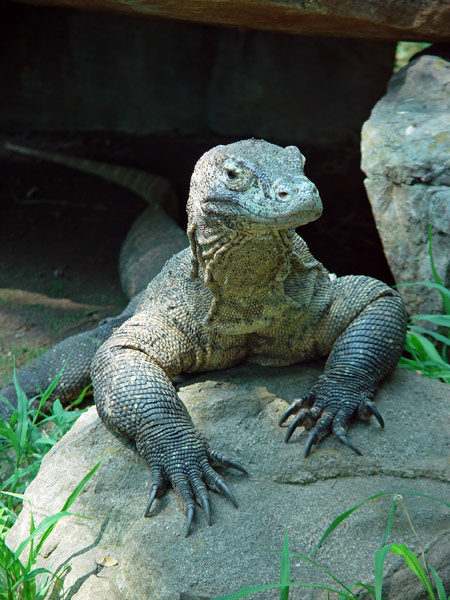
SEE THE SHARP, CURVED
CLAWS.
The Komodo Dragon is an enormous reptile that can grow up to three meters long and weigh 150kg. They are incredibly strong and powerful with long, thick bodies, short, muscular legs and an almighty tail that is used for both fighting and for propping the animal up when it is standing on it's hind legs. The Komodo Dragon has long and sharp, curved claws that are often used for digging and it's greyish brown skin is covered in small scales and folds around the neck. Komodo Dragons have relatively small heads compared to their large body size and wide, powerful jaws that conceal a mouth that is filled with deadly bacteria. Although the Komodo Dragon has good eyesight, the majority of it's surroundings are sensed to smell which the Komodo Dragon does with it's long and deeply forked tough. By flicking it's tongue out of it's mouth, the Komodo Dragon is able to "taste" scent particles in the air to locate both live and dead prey up to 8km away.
KOMODO DRAGON DRAWING,
THEY ARE VERY FIERCE.
Although the Komodo Dragon would have once been widespread across many Indonesian islands, they are today confined to just five which all lie in the Komodo National Park. The islands of Komodo, Rintja, Gillimontang, Padar and the western tip of Flores are the last remaining homes for these enormous animals that are most commonly found in open woodlands along with dry savannah and on scrubby hillsides, and can also be found inhabiting dried-up river beds. It is thought that Komodo Dragons evolved to be so big on these islands due to the presence of a number of large mammalian species that have since gone extinct. Today however, they are becoming more threatened in their natural environments with the loss of their habitats to deforestation for timber has pushed the last remaining populations into smaller and more isolated regions.
THEY ARE GOOD SWIMMERS TOO!
The Komodo Dragon is a solitary and powerful predator that roams a territory which is dependent on the individual's size, with the average adult covering a distance of around 2km every day. They are also known to be excellent swimmers, travelling from one island to another over a relatively long distance. Although they are solitary animals, a number of Komodo Dragons will often gather around a single kill with smaller individuals normally having to give way to the larger ones. In order to catch such large animals, Komodo Dragons can sit for hours hidden in the vegetation and are well camouflaged by their grey-brown skin as they sit waiting for a prey animal to pass by. The Komodo Dragon then ambushes it's victim with incredible speed and force. Although the majority of initial attacks are successful, if the animal somehow manages to escape then the bacteria transferred from the Komodo Dragon's mouth in the bite-would, causes the flesh to become septic and kills the prey within 24 hours.
BABY KOMODO DRAGONS.
Besides when feeding on a large carcass, Komodo Dragons can also be seen in the company of one another during the breeding season when, in September, nearby males fight one another by standing on their hind legs and propped up by their tails, try to win the right to breed with the local females. After mating, the female Komodo Dragon lays up to 25 leathery eggs in a hole that she digs into the soft sand. The young hatch after an incubation period that lasts for between 8 and 9 months and are boldly marked with cream bands (which they lose as they get older), and are completely independent from when they leave their shell. However, until they grow to a larger size, young Komodo Dragons will venture up into the trees where they will spend most of their time until they are big enough to look after themselves on the ground. Komodo Dragons tend to live for an average of 30 years in the wild.
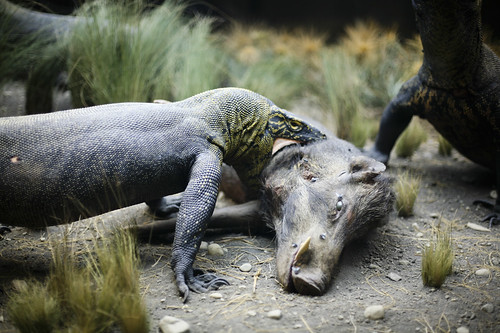
KOMODO DRAGON EATING A
WILD BOAR.
The Komodo Dragon is a carnivorous animal that only hunts and kills large animals in order to survive in it's natural surroundings. Adult Komodo Dragons are able to kill prey much larger than themselves as even if they are not successful at killing it on ambush, they will then follow it for miles until it eventually dies of the blood-poisoning caused by the deadly bacteria in the Komodo Dragon's mouth. Largemammals make up the bulk of the Komodo Dragon's diet including PigsGoatsDeer and even Horses and Water Buffalo (all of which have been introduced to the islands by people). Young Komodo Dragons however, prey on smaller animals in the trees such as SnakesLizards and Birds. The teeth of the Komodo Dragon are sharp and serrated but they mean that this animal cannot chew. Instead they tear bits off the carcass and throw it backwards into their mouths, able to swallow it whole aided by their flexible neck muscles.
KOMODO DRAGON STAMPS
The Komodo Dragon is known to have fifty different types of toxic bacteria in their saliva that thrive on traces of flesh, causing bite-wounds to become quickly infected. Recent research however, indicates that the real reason for such a high success rate in poisoning it's prey could be down to the fact that the Komodo Dragon may have a venom gland in it's mouth. Although Komodo Dragons have thrived in this part of the Indonesian archipelago for millions of years, they were not known to the world until around a century ago when reports came in from a pilot that swam to Komodo Island after his plane went down. The immense size of the Komodo Dragon is thought to come from the fact that they would have once hunted large mammals that would have then existed in Indonesia, including a species of Pygmy Elephant which is thought to have now been extinct for thousands of years. This means that the main prey of the Komodo Dragon today, has all been introduced to the islands by Human settlers.

Wednesday, November 9, 2011

Okapi

The Okapi is an elusive herbivore that is found in a small pocket of tropical mountain forest in centralAfrica. Despite it's Deer-like appearance the Okapi is actually one of the last remaining ancestors of the Giraffe, which is the tallest animal on Earth. Along with having a relatively long neck compared to it's body size, the most striking feature of the Okapi is the horizontal stripes that are particularly visible on their behinds and give this animal an almost Zebra-like appearance. The Okapi is very shy and secretive, so much so in fact that they were not recognised as a distinct species by western science until the earth 20th century. Although they are seldom seen by people, the Okapi is not an endangered species as they are thought to be fairly common in their remote habitats.
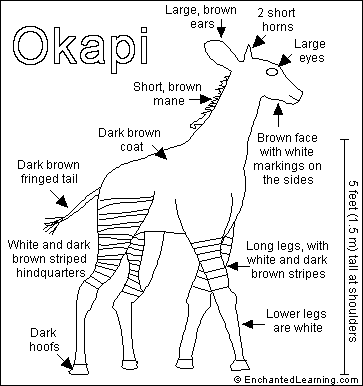
A BRIEF DESCRIPTION. 
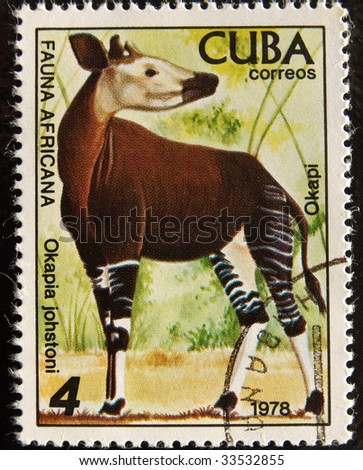
Like it's distant and much larger ancestor, the Okapi has a long neck which not only helps it to reach leaves that are higher up, but also provides the Okapi with a tool to both defend itself and it's territory. The Okapi has a red-brown coloured coat of fur with horizontal, white striped markings that are found on their hind quarters and at the tops of their legs, and provide the Okapi with excellent camouflage in the dense jungle. They have white ankles with a dark spot above each hoof and very thick skin to help protect them from injury. The Okapi has a long head and dark muzzle with large set-back ears which enable the Okapi to detect approaching predators easily. The Okapi also has an impressively long tongue, which is not only black in colour but it is also prehensile meaning that it is able to grab hold of leaves from the branches above.
PICTURE OF AN OKAPI IN A
STAMP.
The Okapi is found in the dense tropical rainforests of north-eastern Democratic Republic of Congo generally at an altitude that can vary between 500 and 1,000 meters, although the majority of individuals are thought to inhabit areas at roughly 800 meters above sea level. They are incredibly shy and elusive animals and rely heavily on the very thick foliage around them to protect them from being spotted by predators. The Okapi can also be found in areas where there is a slow-moving fresh water source, but the range of the Okapi is very much limited by natural barriers, with unsuitable habitats on all four sides trapping these animals into the 63,000 square kilometre Ituri Rainforest. Around a fifth of the rainforest is today made up of the Okapi Wildlife Reserve, which is a World Heritage Site. Although they are thought to be common in their native region, the Okapi has been severely threatened by habitat loss particularly from deforestation.
THEY MAKE THE SOUND ''CHUFF'',
The Okapi is a diurnal animal meaning that they are most active during the day when they spend the majority of their time roaming set paths through the forest in search of food. They are solitary animals with the exception of the time mothers spend with their calves but are known to tolerate other individuals and may occasionally feed together in small groups for a short period of time. Okapi have overlapping home ranges with males tending to occupy a larger territory than females, which is marked with both urine and by rubbing their necks on trees. Males also use their necks to fight with one other to both settle disputes over territory and to compete to mate with a female during the breeding season. Okapis are known to also communicate with one another using quiet "chuff" sounds and rely heavily on their hearing in the surrounding forest where they are not able to see very far at all.
A BABY OKAPI!
After a gestation period that can last for up to 16 months, the female Okapi retreats into the dense vegetation where she gives birth to a single calf. Like many hoofed-herbivores, the Okapi calf is usually able to stand within half an hour when mother and baby then begin starting to look for a good nest spot. They remain in their nest deep in the undergrowth for the majority of the next two months which not only helps the calf to develop more rapidly but also gives it vital protection from hungry predators. Although the female Okapi will protect and feed her vulnerable calf, the two are not thought to share the same close bond that occurs with numerous other hoofed mammals. Although they do begin to develop their white stripes at a fairly young age, the young Okapi do not reach their full adult size until they are roughly three years old. They are generally weaned at around 6 months old but may continue to suckle from their mother for more than a year.
OKAPI PAINTING!
The Okapi is a herbivorous animal meaning that it survives on a diet that is only comprised of plant matter. They eat leaves, shoots and twigs that are drawn into their mouths using their long prehensile tongue along with fruits, berries and other plant parts. The Okapi will even eat fungi on occasion and is known to eat more than 100 different types of plant, many of which are poisonous to other animals and Humans. Along with consuming a vast variety of plant material, the Okapi is also known to eat a reddish clay that provides essential salt and minerals to it's plant-based diet. The Okapi spends a great deal of the daylight hours in search of food and walks quietly along well-trodden paths that it uses regularly to ensure an easier escape from predators.
LONG NECK TO BITE
TALL TREE LEAVES!
One of the most distinctive features of both the Okapi and the Giraffe is their long prehensile tongue which can not only be used to grab onto leaves and branches but it also assists the animal when grooming. The tongue of the Okapi is in fact so long, that they are one of the few animals in the world that are said to be able to lick their own ear! Although they are quite rare and very secretive animals, there were sightings of the Okapi in these forests but these generally involved seeing the animal from behind and so the Okapi was known by many as a Forest Zebra. The Okapi was not classified as a distinct species until 1900 - 1901, when Harry Johnston sent two pieces of Zebra-like skin to London which was analysed and meant that a new species had been recorded.

Field Spaniel

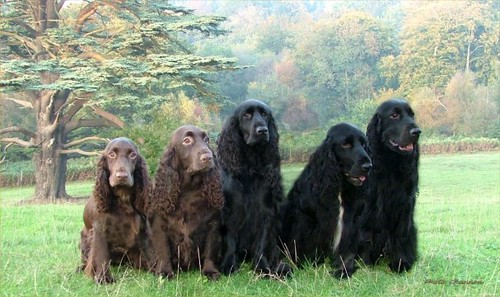
The Field Spaniel is a moderately-sized dog that has a heavier and longer build than a Cocker Spaniel. Since it has a rich and lustrous coat, this dog breed is commonly used as a show dog and has one of the sweetest and mild-mannered personalities. Its coat is silky and generally solid in color. Some breeds have tan and speckled markings, while others have spots of white on the chest. The silky coat is usually either liver-colored or all black. 

The Field Spaniel's coat is usually feathered but never curly. These dogs have regular-sized muzzles, and large noses with open nostrils. A gentle but noble expression is common for this breed, and almond-shaped eyes in hazel or chestnut brown are signature traits. The face is lean, thin, and attractive; this is an important feature for show dogs and makes the Field Spaniel especially desirable. The eyes are not too full, and may be nearly black. They often have a grave expression that further emphasizes their natural docility. Ears are usually set low which adds to the beauty of the head. They have natural Setter-like feather that makes the head and neck area especially attractive. The neck is usually strong, muscular, and lean; these dogs stand tall and confdient, and have moderatealy long, fringed ears. The tail is usually docked and tucked under. The body is long and very low, and a well-ribbed dog will stand straight or slightly arched. 

Field spaniels are natural sporting dogs and are capable of creating a very beautiful and useful stage presence. 

Trianing the field spaniel can take time but the effort is worthwile; this breed makes an excellent show dog and is easily trainable after only a few sessions. After initial bonding time with the owner, a Field Spaniel becomes especially loyal and can be a great companion dog as well. Its mild manners and even temperament make it suitable for a variety of households, families, and owners
THIS ONE IS SO NICE.
The Field Spaniel is best suited for a house or larger living space simply because they need to run about in a yard or fenced in area. They are not well suited for apartment homes or smaller dwellings since they can become neurotic and temperamental if they do not have enough space. These dogs still have roots in natural hunting environments, and it is important that they are not let out of sight on a regular basis. A fenced-in property is the safest place for these dogs to roam and run in, as they are likely to simply follow a scent if they are left unattended. This breed prefers cooler climates and will exhibit neurotic behavior if it is simply locked away.
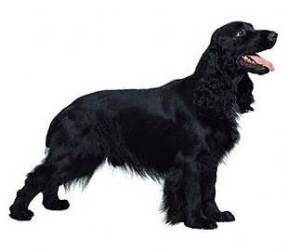
THEY HAVE VARIOUS COLORS.THEY HAVE A FINE COAT
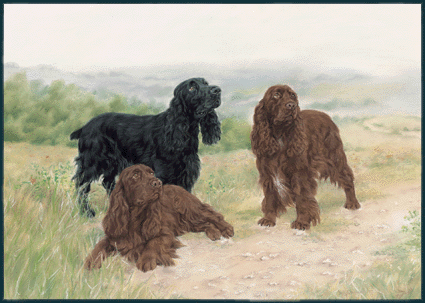
The Field Spaniel has a thin and glossy coat can be speckled or just plain tan with white spots. The coat is of moderate length and can be flat or slightly wavy. This breed is highly weather resistant, and thus prefers cooler climates and even wet weather. The most common coat is black, but some coats may also be mahogany red, golden liver, or plain liver in color. White in the chest area is also fairly common.
A FIELD SPANIEL PUP.
4 - 8 puppies with the average being 6 puppies.The life span of a field spaniel is 10-12 years.
The Field Spaniel is incredibly docile, calm, but also independent in nature. These dogs are smart, intelligent, and playful; they are also very active and can be full of energy. They make excellent family pets because of their drive to please and friendly nature, and they are especially good with young children because of their soft and docile presence. It is important that this breed is socialized well so that they do not become too timid; this is a natural trait and they can be very friendly and sociable once they break out of their comfort zone. If the dog is under socialized in early years, it will be much less likely to interact with strangers.

Field spaniels enjoy roaming and exploring, and are often involved with playing and activities. If play becomes too rough, however, they may become timid, withdrawn, and unsociable. It is important to monitor them in their early years so that they do not become temperamental in new situations. Tehse dogs have a tendency to become stubborn, but they are calm and placid overall. They become very happy when they have an activity to do or a project to complete; they are quick learners and will pay attention to direction and the owner's voice. Training the Field Spaniel is relatively easy and they are very sensitive to voice, tone, and manners. It is important to be direct and not too harsh with these dogs as they will pick up any nuances and behaviors immediately. A tough approach will likely disturb them and may result in reluctant behavior traits.

The Field Spaniel is famous for becoming devoted to only one family member and ignoring other parties as a result. They can become neurotic if they are locked away in a kennel, and need regular contact with a variety of people. These dogs are very trustworthy, dependable, and loyal. They can be very affectionate and loving, and become excellent family dogs over the long term. The Field Spaniel matures at an average rate, and is a quick learner and eager to grow by learning new skills.

Tuesday, November 1, 2011

Jack Russell Terrier

The Jack Russell Terrier is a small, miniature-sized version of a working Fox Terrier, and is often confused for this breed. However, it has distinct qualities and fun-loving, merry personality. The dog is usually white with reddish black and brown markings, and can often have many large tan patches. The skull is flat between the ears, and these usually flow to a tapering point. The stop is well-defined, and the dog has almond shaped eyes with a black nose. Eyes are usually dark brown or near-black, and the dog has one of the most "pitiful puppy" dog looks!

The Jack Russell Terrier has a very flexible body and is incredibly agile. It has a medium to small chest and this helps them run and chase after prey that are close to the ground. Highly active and usually always on the run, these dogs are athletic with plenty of energy. The docked tail is carried high and they carry themselves with a lot of energy and a strong attitude. The dogs come in smooth and wire-haired versions, although the broken coat can also be quite rough. The slightly fuzzy face and smooth head are natural qualities of this dog and the Irish types often have shorter legs than English types.

The dog is usually more white than other colors, and has its origins in fox hunting. The Jack Russell Terrier is often simply called the "Jack Russell" and has been used to describe many different types of small terriers of similar stature. These dogs tend to get very excited, and are wonderful with children. These dogs have been raised to be working terriers, and have a strong expression and distinct appearance. The red fox is the most common prey for these dogs, and they are commonly found hunting down red foxes and old badgers in dens and quarries. The Jack Russell Terrier is small enough to burrow into quarries and dens, and will gladly pursue a variety of small animals. These dogs jump at the chance to explore new territory, and it is not uncommon to find them "stuck" in a den or hole after a relentless search for their next find!

These dogs also have crooked or "benched" legs and this can be a sign of Achondroplasia. Still, they are built strong and muscular and they have a strong drive to work and stay active despite any physical limitations. These dogs are well-proportioned in relation to height and have an attractive appearance overall.

Training these dogs requires patience, diligence, and persistence. Since these dogs naturally have a high energy level, it can be difficult to keep up! Still, the discipline instilled at an early age will help to manage them in later years and they are more likely to bond with owners as a result.
JACK RUSSELL TERRIER PUPS!
The Jack Russell Terrier has a white coat with black, tan, and brown markings and often has reddish tones. The coat is moderately long and not dense, but medium textured and soft.
They litter 4-8 pups ,average 6(six).
living area
The Jack Russell Terrier is suited for apartments only when they receive an adequate amount of exercise. They do not do well by being chained up all day as they need the freedom to explore and move about. These dogs are not well-suited for kennels for extended periods of time, although they do enjoy the outdoors. They are very active indoors, and it is important to keep valuables and fragile objects out of their living space whenever possible. Although they may not be directly destructive, they do have a tendency to be hyperactive and can cause damage to fragile goods and objects as a result. These dogs should be accompanied by a person during the day and can be crate trained. However, they will need some exercise throughout the day as well as plenty of affection!

These dogs thoroughly enjoy interaction with their owners, and can develop strong bonds as a result. They will enjoy new environments to explore, and will fare well with a small yard or fenced in space of their own.
JACK RUSSELL TERRIER ART.IT IS SITTING IN A SOFA.
The Jack Russell Terrier is happy, devoted, loving, and very perky. It will rise up early in the morning and play about at its leisure, but most enjoys its time with a job to do. These dogs are amusing and entertaining, and will be eager to play with new toys, games, and people. They are friendly and kind towards children and strangers and will happily introduce themselves to new people. These dogs are very determined and independent as well; it is important to remember this when they are during their training stages as they can be difficult to manage at times. Still, diligence and perseverance with these dogs will pay off.

The Jack Russell Terrier may be aggressive with other dogs, especially during its early years of socialization. This is why it is especially important for these dogs to learn from early socialization and they must be introduced to different dogs and animals whenever possible. These dogs do have natural hunting abilities and a strong instinctive quality. They are stronger than the average terrier and should generally not be trusted with smaller animals. They are driven to hunt, so it is important to keep them on a tight leash in new territory. Unless they are very well-trained, these dogs can be difficult to manage off the leash and may run off far from home.

These dogs can become destructive if they are restless or bored, and it is important that they have plenty of activities to enjoy when they do not have access to formal exercise. Regular activity will keep them from becoming occupied in harmful actions and activities overall. The Jack Russell Terrier is a natural climber and can jump and climb over fences relatively easily. These dogs do get excited very easily and are strong-willed; they will do their best to achieve a goal and will run after new things easily. Making sure they are well-trained well before they have a chance to do so is in the owner's best interest.

These dogs are very loving and affectionate, and will need constant attention. They will turn to excessive barking and other unmanageable behavior if they are not getting the attention they need, and may even resort to digging and destroying objects in the home. It is important to vary their activities and make sure they are actively engaged with the family on a regular basis. These dogs do have a tendency to be "cat-aggressive" and will not get along well with other small animals in the home. They often get involved in fights with rabbits and other small fur-bearing animals so it is important that they are kept far from the cages of any household pets as often as possible.

These dogs are inquisitive and curious, and due to their small sizes, can find themselves in a lot of trouble very easily! It is important to remember that these dogs do not enjoy being "lap dogs" and would rather play about freely. They are not comfortable sitting in one place for extended periods of time, and will need to be taken to new environments and settings on a regular basis.
''         '' PLAYING WITH  BALL!
The Jack Russell Terrier is very adaptable to different environments, but does require a lot of exercise on a regular basis. Owners can expect to become athletic and build endurance themselves; these dogs enjoy running, walking, and jogging outdoors as well as playing standard games such as fetch or with a ball. Since they are constantly active indoors as well, these dogs need plenty of stimulating toys and activities during "rainy days." They tend to become destructive and irritable if they are bored, and it is important that they are given the freedom to run and play about if they are inside for extended periods of time.

The ideal workout for these dogs is about two long walks or light jogs per day. These dogs are naturally early risers and will expect to get exercise immediately after waking. They need open spaces to run, hunt, play, and explore; taking them to a dog park or other open field for a day is perfect for fulfilling their exercise needs.

These dogs are quick learners and highly intelligent. Although they may run off from their owners, they can return quickly after careful training. It is important to keep them on a leash until they are well-trained so that they do not get lost. These dogs have superb stamina and endurance, and older owners may have difficulty keeping up. Naturally hyper and overactive, these dogs are relentless when finding physical activities to participate in!

Cheetah

The Cheetah is a large and powerful feline that was once found throughout Africa and Asia and even in parts of Europe. Today however, it is found in only a few remote regions of it's once vast natural range, primarily due to growing Human settlements and the hunting of them for their fur. There are widely considered to be five different subspecies of Cheetah that vary only very slightly in colouration and are most easily distinguished by their geographic location. Although they are not considered to be part of the 'bigcat' family as they cannot roar, Cheetahs are one of Africa's most powerful predatorsand are most renowned for their immense speed when in a chase. Capable of reaching speeds of more than 60mph for short periods of time, the Cheetah is the fastest land mammal in the world.
A SEQUENCE OF THE RUNNING PATTERNS.
The Cheetah has a long and slender body that is covered in coarse yellowish fur and dotted with small black spots. It's long tail helps with balance and changing direction quickly and unlike the rest of the Cheetah's body, there are ringed markings along the tail which ends in a black tip. Cheetahs have small heads with high set eyes that aid them when surveying the surrounding grasslands for potential prey. They also have distinctive black "tear marks" that run from the inner eye, along their nose and down to the outside of their mouths, which are thought to help protect them from being blinded by the bright sun. The exceptional speed of the Cheetah is caused by a number of things including having strong and powerful hind legs, and an incredibly flexible and muscular spine which allows the Cheetah to not only sprint quickly but also makes them very agile. They also have non-retractable claws which dig into the ground, giving the Cheetah better grip at high speed.
A PENCIL DRAWING OF A CHEETAH
WALKING.
The Cheetah once had a vast historical range that stretched across a number of continents, but their distribution today is much more scattered with a small number found in Iran and the majority found in sub-Saharan Africa. Although Cheetahs are still found in a few different parts of eastern and southern Africa, the highest population of wild Cheetahs is now found in Namibia in south-western Africa. Cheetahs are most commonly found stalking prey on the vast, open grasslands but they are also found in a variety of other habitats as well including deserts, dense vegetation and mountainous terrain, providing that there are both adequate supplies of food and water. Cheetahs are one of Africa's most vulnerable felines with population numbers being mainly affected by growing Human settlements that encroach on their native habitats.
The Cheetah is unique amongst Africa's felines primarily because they are most active during the day, which avoids competition for food from other large predators like Lions and Hyenas that hunt during the cooler night. They are also one of the more sociable Cat species with males often roaming in small groups, generally with their siblings, and oddly enough, it is the females that are more solitary animals apart from the 18 months or so that they spend looking after their cubs. Cheetahs are fiercely territorial animals that patrol large home ranges and often overlap those of other Cheetahs, and indeed Lions, with females tending to roam across a much larger range than males. They are typically shy and very stealthy animals so that they are able to hunt for prey in the hot daylight hours without being spotted so easily.
CHEETAH WITH HER ADORABLE CUBS
After a gestation period that lasts for around 3 months, the female Cheetah gives birth to between two and five cubs that are born blind and incredibly vulnerable in the African wilderness. The cubs suckle from their mother for the first few months when they begin eating meat, and start to accompany her on hunting trips as they are able to learn how to hunt from watching her. Cheetah cubs learn the majority of their hunting techniques through playing with their siblings, and remain with their mother until they can hunt successfully and leave to find their own territory at between 18 months and 2 years old. Sadly, one of the main reasons for such drastic declines in Cheetah numbers is that up to 75% of Cheetah cubs don't live to be older than 3 months, as their mother has to leave them everyday to find food to feed them, leaving the vulnerable cubs helpless in the face of predators.
TWO CHEETAHS CHASING A DEER
The Cheetah has exceptional eyesight and so hunts using sight by first stalking it's prey (from between 10 to 30 meters away), and then chasing it when the time is right. Cheetahs often kill their prey in vast open spaces but tend to drag it into a hiding place to prevent it from being scavenged by other animals. The Cheetah has to do this as it cannot eat it's prey straight away, due to the fact that they are immensely hot after the chase and need time to cool down before they can feast. Cheetahs are carnivorous animals meaning that they only hunt and kill other animals in order to get the nutrition that they need to survive. They mainly hunt large herbivores including Gazelle and a number of large Antelope species such as Wildbeest, along with Zebras and smaller mammals like Hares. The exact diet of the Cheetah though tends to depend on it's location.
KING CHEETAHS
One of the most distinctive differences between the different subspecies is that their fur colour changes slightly, depending on their surrounding environment. Those Cheetahs found in the more arid desert regions tend to be lighter and have smaller spots than the King Cheetahs that roam the south African grasslands, and are darker, slightly bigger and have larger spots. Although Cheetahs cannot roar, they do make a variety of different sounds including a high-pitched yelp which can be heard for more than a mile away. The Cheetah is one of the most distinctive of the world's felines and although it is fairly commonly confused with the Leopard, it's name is thought to have come from the Hindu word 'chita' which means the 'spotted one'.
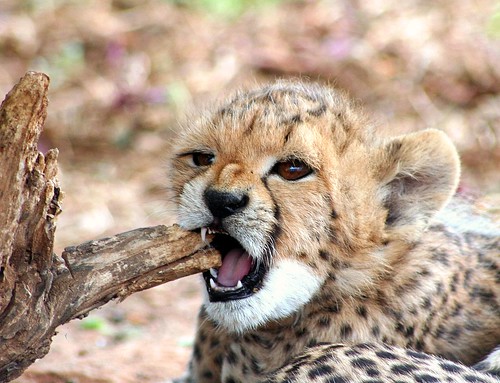
BABY CHEETAH CHEWING A BRANCH
OF TREE BECAUSE THEY ARE SMALL.
Despite their fierce appearance, Cheetahs have actually been domesticated by local people for thousands of years, as they were used to help with hunting for food for the villagers. They have also been kept in captivity for a long time, but as they do not seem to produce particularly healthy individuals, wild Cheetahs were regularly caught to restore the bloodline. Hunted by people as trophies throughout much of their natural range, Cheetahs have completely disappeared from numerous places and along with habitat loss to growing Human settlements and the clearing of land for agriculture, Cheetah numbers are still declining rapidly in many areas today.

Monday, October 31, 2011

African Bush Elephant

The African Bush Elephant is the largest of all living creatures on land today, with some individuals growing to weigh more than 6 tons. The Elephant is thought to have been named after the Greek word for ivory, meaning that Elephants were named for their uniquely long tusks. Although many of the ancestors of the African Bush Elephant became extinct during the last ice-age (including the Woolly Mammoth), there are three distinct species of Elephant remaining today which are the Asian Elephant (of which there are a number of sub-species), the African Bush Elephant and the African Forest Elephant. Although these two Elephant species are very similar, the African Bush Elephant is considered to be generally larger than the African Forest Elephant, which has rounder ears and straighter tusks.
CAN DRINK UP TO 50 GALLONS OF
WATER A DAY
The African Bush Elephant is the largest known land mammal on Earth, with male African Bush Elephants reaching up to 3.5 metres in height and the females being slightly smaller at around 3 metres tall. The body of the African Bush Elephants can also grow to between 6 and 7 meters long. The tusks of an African Bush Elephant can be nearly 2.5 meters in length and generally weigh between 50 and 100 pounds, which is about the same as a small adult Human. African Bush Elephants have four molar teeth each weighing about 5.0 kg and measuring about 12 inches long. As the front pair of molars in the mouth of the African Bush Elephant wear down and drop out in pieces, the back pair shift forward and two new molars emerge in the back of the African Bush Elephant's mouth. African Bush Elephants replace their teeth six times during their lives but when the African Bush Elephant is between 40 to 60 years old, it no longer has teeth and will likely die of starvation, which is sadly a common cause of death of Elephants in the African wilderness.
THEY LIVE IN GRASSY PLAINS.
Although the historical range of it's ancestors ranged right into the Arctic Circle, today the African Bush Elephant is mainly found in central and southern Africa in nomadic herds that wander the plains and grasslands of Africa grazing for food and searching for waterholes. Unlike the slightly smaller African Forest Elephant, the African Bush Elephant inhabits the grassy savanna plains and shrub-land of the African continent in groups that contain mothers and their calves. Generally African Bush Elephant herds contains around 10 individuals but it is not uncommon for family groups to join together, forming a clan which can contains over 1,000 Elephants. This very social lifestyle means that the African Bush Elephants are less vulnerable on the open African plains.
THEY ALWAYS ARE TOGETHER.
Not only is the African Bush Elephant an incredibly sociable mammal but it is also a very active one. African Bush Elephants are nomadic animals meaning that they are constantly on the move in search of food, so moving within these family herds allows them to have greater protection both from predators and from the elements. The trunk of the African Bush Elephant is one of it's most distinguishing features and this extra long nose is not only flexible enough to gather and handle food but can also collect water. It's trunk, along with it's tusks can also be used to defend itself from predators such as Lions, and to fight with other male African Bush Elephants during the mating season. African Bush Elephants are also considered to be highly intelligent and emotional animals displaying behaviours that include giving and receiving love, caring deeply for the young and grieving for dead relatives.
THE ''                '' ELEPHANT
ALWAYS CARE TH E BABIES.
TWO CUTE BABY AFRICAN
ELEPHANT TWINS PLAYING!
African Bush Elephants tend to live relatively long lives, with the average life span being between 60 and 70 years, Female African Bush Elephants reach sexual maturity (are able to reproduce) after 10 or 11 years, but are thought to be most fertile between the ages of 25 and 45. Male African Bush Elephants however, often don't reach sexual maturity until they are nearly 20 years old. After mating and a gestation period of up to 2 years, the female African Bush Elephant gives birth to a single calf (twins have been known but are extremely rare). The African Bush Elephant calf is nursed for 2 years but will remain under the guidance and protection of the herd until it is old enough to support itself (around 6 years old). It is at this point that the tusks of the African Bush Elephant calf will be starting to grow.
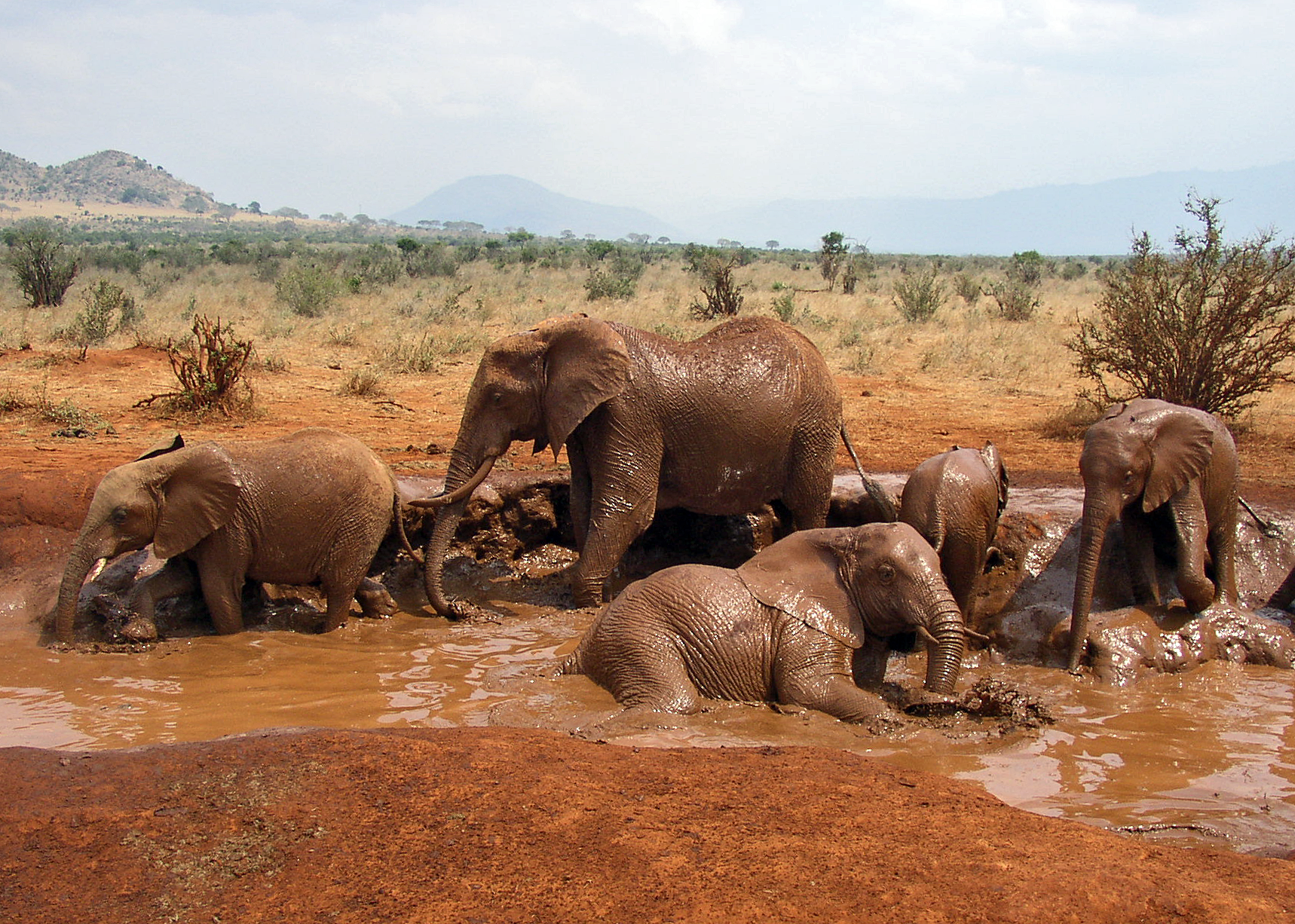
AFRICAN BUSH ELEPHANT HAVING
A MUD BATH.
Despite it's immense size, the African Bush Elephant is a herbivorous mammal meaning that it survives on a diet that solely consists of plants and plant matter. The bulk of the African Bush Elephant's diet is comprised of leaves and branches that are stripped off the trees and bushes using it's trunk. The African Bush Elephant also grazes on fruits and grasses and uses it's immense tusks for digging for roots in the ground and to strip the beh of the African Bush Elephant are then the perfect tool for grinding the vegetation and course plants down so that they can then be more easily digested.
In the early 19th century, the story of the African Bush Elephant was very different with their being up to 5 million individuals thought to have been roaming the African continent. However due to the increased demand for ivory, Africa's Bush Elephant population is thought to have fallen as much as 85% in some areas. The large ears of the African Bush Elephant are said by some to be shaped somewhat like Africa, but these large flaps of skin are not just for hearing, they are a vital tool in keeping the Elephant cool in the African heat. Like many of the herbivores found throughout Africa, the calves can walk at birth to maximise their chances of survival. An adult African Bush Elephant can drink up to 50 gallons of water every day, and is able to take 1.5 gallons of water into their trunks at at time.

Tuesday, October 18, 2011

Puma

The Puma is a large, secretive Cat predominantly found in the mountains from southern Canada to the tip of South America. Also commonly known as the Cougar and the Mountain Lion, Pumas are able to reach larger sizes than some 'big' cat individuals but despite their large size they are believed to be more closely related to smaller feline species. Due to their extensive distribution, there are 7 subspecies of Puma all of which share similar characteristics but tend to vary slightly in colour and occasionally size. The Puma is thought to be one of the most adaptable felines on the American continents as they are found in a variety of different habitats and unlike numerous Cat species, the Puma has no markings on it's fur leading to it's scientific name Felis concolor which means'cat of one colour'.
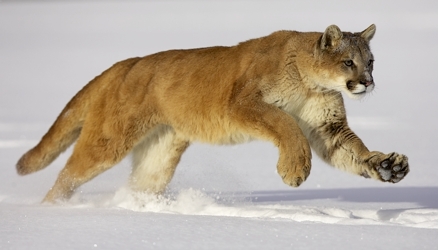
THEY ARE STRONG.
Due to the fact that the majority of Pumas are found in more mountainous regions, they have a thick coat of fur which helps to keep them warm in the freezing winters. Depending on the subspecies and location, the Puma's fur varies in colour from brown-yellow to grey-red, with those individuals found in colder regions being more grey and those found in warmer areas having more of a red tinge to their fur. The Puma is an incredibly powerful predator and has muscular hind legs that are slightly longer and stronger than the front, which makes them more agile when leaping. The also have enormous paws which are very large in comparison to their body size. The Puma has large wide-set eyes which not only enable it to see what is ahead of it, but they can also see for some distance around them as well. They have pointed ears and their acute hearing allows them to detect prey even when it is too dark for them to see.
IT IS FOUND ON MOUNTAINS.
The Puma is found in the mountains throughout South and North America where it inhabits rocky crags and pastures slightly lower down than the slopes than the grazing herbivores. Although these seem to be the Puma's preferred conditions they are extremely adaptable animals that can be found in a variety of habitats including forests, tropical jungle, grasslands and even in more arid desert regions. However, with expanding Human settlements and land clearance for agriculture, the Puma is being pushed into smaller pockets of it's historically vast range, retreating into more hostile mountain environments that are further away from people. It is widely believed however that the Puma's adaptability has been vital in ensuring that it doesn't disappear from the wild forever.
The Puma is a solitary animal with the exception of the time cubs spend with their mother. Pumas patrol large home ranges in search of food which varies from 80 square miles in the summer to 40 in the winter, when the falling snow restricts access to a number of mountain areas. Some regions can become so hostile that Pumas migrate from the mountain forests and go down into the valleys to escape the worst of the cold. Not only can Pumas easily adapt to different surroundings but they are also able to hunt effectively during the day or night. Their strong and muscular hind legs and large paws mean that the Puma can move about amongst the rocks more quickly and with greater agility. Pumas are known to make a variety of different sounds particularly when warning another Puma away from their territory and during the mating season when they are looking for a mate.
PUMA CUB CLINGING
TO A BRANCH OF A
TREE.
The breeding season tends to occur between December and March with litters of up to 6 cubs being born after a three month gestation period, generally between February and September. After mating, the male and the female part company and he will continue to mate with other females for the duration of the season. Like numerous other felines, Puma cubs are born blind and are completely helpless for their first two weeks of life until their blue eyes fully open. Unlike the one-colour adult Pumas, cubs are born with spots on their fur which helps them to be more easily camouflaged from hungry predators. They are able to eat solid food when they are between 2 and 3 months old and remain with their mother for about a year. Many Pumas live to an average age of 12 years but they have been known to reach 25 years old in captivity.
A DOG WITH PUMA CUBS.WHAT A BEAUTIFUL SCENERY.
The Puma is a large and powerful carnivore, hunting and eating only other animals in order to survive. The majority of the Puma's diet is comprised of small animals like Mice, Rats, Birds, Fish and Rabbits that are found living in a high abundance on the fertile mountain slopes and in the lowland forests. The large size of the Puma though also means that it can hunt bigger animals including Sheep, Racoons, Goats and livestock which it catches by pouncing onto the animal to secure it. The Puma is not only big, but it's agile and incredibly muscular body means that it can easily outrun many of the species that it hunts.
One of the most obvious reasons as to why this large and powerful feline is not classified as one of the world's 'big' Cats is that Pumas are not able to roar. This is something distinctive to the 'big' Cat family as no other feline is able to do so. The powerful hind legs of the Puma are so muscular that they not only allow them to pounce on and secure their prey, but they are also able to leap enormous distances of up to 20ft. One of the most famous subspecies of Puma is the Florida Panther which is the smallest of the Puma species and also the rarest. Thought to be on the brink of extinction, this endangered animal has more of a red tinge to the fur on it's back along with having a dark spot in the centre.