Friday, September 2, 2011

Snow Leopard


The snow leopard (Uncia uncia or Panthera uncia) is a moderately large cat native to the mountain ranges of South Asia and Central Asia. The classification of this species has been subject to change and its exact taxonomic position will not be resolved until further studies are conducted.
Snow leopards live between 3,000 and 5,500 metres (9,800 and 18,000 ft) above sea level in the rocky mountain ranges of Central and South Asia. Their secretive nature means that their exact numbers are unknown, but it has been estimated that between 3,500 and 7,000 snow leopards exist in the wild and between 600 and 700 in zoos worldwide.
Snow leopards are smaller than the other big cats but, like them, exhibit a range of sizes, generally weighing between 27 and 55 kilograms (60 and 120 lb). Body length ranges from 75 to 130 centimetres (30 to 50 in), with the tail adding an additional 75 to 90 percent of that length.These cats stand about 60 cm (24 in) at the shoulder.
Snow leopards have long thick fur, and their base color varies from smoky gray to yellowish tan, with whitish underparts. They have dark gray to black open rosettes on their body with small spots of the same color on their heads and larger spots on their legs and tail. Unusually among cats, their eyes are pale green or gray in color.
Snow leopards are unusual among large cats in that they have a well-defined birth peak. They usually mate in late winter, marked by a noticeable increase in marking and calling. The Snow Leopards have a gestation period of 90–100 days, so that the cubs are born between April and June. Oestrus typically lasts from five to eight days, and males tend not to seek out another partner after mating, probably because the short mating season does not allow sufficient time. Paired snow leopards mate in the usual felid posture, from 12 to 36 times a day.
STAYING WITH IT'S MOTHER INSIDE
THE DEN.
The mother gives birth in a rocky den or crevice lined with fur shed from her underside. Litter sizes vary from one to five cubs, but the average is 2.2. The cubs are blind and helpless at birth, although already with a thick coat of fur, and weigh from 320 to 567 grams (11 to 20.0 oz). The eyes open at around seven days, and the cubs can walk at five weeks and are fully weaned by 10 weeks.Also when they are born they have full black spots and turn into rosettes as they grow up.
The cubs leave the den at around two to four months of age, but remain with their mother until they become independent after around 18–22 months. Once independent, they may disperse over considerable distances, even crossing wide expanses of flat terrain to seek out new hunting grounds. This likely helps reduce the inbreeding that would otherwise be common in their relatively isolated environment. Snow leopards become sexually mature at two to three years, and normally live for 15–18 years, although in captivity they can live for up to 21 years show several adaptations for living in a cold mountainous environment. Their bodies are stocky, their fur is thick, and their ears are small and rounded, all of which help to minimize heat loss. Their paws are wide, which distributes their weight better for walking on snow, and have fur on their undersides to increase their grip on steep and unstable surfaces; it also helps to minimize heat loss. Snow leopards' tails are long and flexible, helping them to maintain their balance, which is very important in the rocky terrain they inhabit. Their tails are also very thick due to storage of fats and are very thickly covered with fur which allows them to be used like a blanket to protect their faces when asleep.
The snow leopard has a short muzzle and domed forehead, containing unusual large nasal cavities that help the animal breathe the thin, cold air of their mountainous environment.
Snow leopards cannot roar, despite possessing some ossification of the hyoid bone. This ossification was previously thought to be essential for allowing the big cats to roar, but new studies show that the ability to roar is due to other morphological features, especially of the larynx, which are absent in the snow leopard.Snow leopard vocalizations include hisses, chuffing, mews, growls, and wailing.

Butterflies


A butterfly is a mainly day-flying insect of the order Lepidoptera, the butterflies and moths. Like other holometabolous insects, the butterfly's life cycle consists of four parts: egg, lava , pupa and adult. Most species are diurnal. Butterflies have large, often brightly coloured wings, and conspicuous, fluttering flight. Butterflies comprise the true butterflies (superfamily Papilionoidea), the skippers(superfamily Hesperioidea) and the moth-butterflies (superfamily Hedyloidea). All the many other families within the Lepidoptera are referred to as moths.
Butterflies exhibit polymorsphim, mimicry and aposematism. Some, like the Monarch , will migrate over long distances. Some butterflies have evolved symbiotic and parasitic relationships with social insects such as ants. Some species are pests because in their larval stages they can damage domestic crops or trees; however, some species are agents of pollination of some plants, and caterpillars of a few butterflies (e.g., harvesters) eat harmful insects. Culturally, butterflies are a popular motif in the visual and literary arts.It is a popular belief that butterflies have very short life spans. However, butterflies in their adult stage can live from a week to nearly a year depending on the species. Many species have long larval life stages while others can remain dormant in their pupal or egg stages and thereby survive winters.
Butterflies feed primarily on nectar from flowers. Some also derive nourishment from pollen,tree sap, rotting fruit, dung, decaying flesh, and dissolved minerals in wet sand or dirt. Butterflies are important as pollinators for some species of plants although in general they do not carry as much pollen load as bees They are however capable of moving pollen over greater distances. flower constancy has been observed for at least one species of butterfly.[21]
Butterflies may have one or more broods per year. The number of generations per year varies from temperate to tropical regions with tropical regions showing a trend towards multivoltinism.
As adults, butterflies consume only liquids which are ingested by means of their proboscis. They sip water from damp patches for hydration and feed on nectar from flowers, from which they obtain sugars for energy as well as sodium and other minerals vital for reproduction. Several species of butterflies need more sodium than that provided by nectar and are attracted by sodium in salt; they sometimes land on people, attracted by the salt in human sweat. Some butterflies also visit dung, rotting fruit or carcasses to obtain minerals and nutrients. In many species, this mud puddling behaviour is restricted to the males, and studies have suggested that the nutrients collected may be provided as a nuptial gift along with the spermatophore, during mating.
Butterflies use their antennae to sense the air for wind and scents. The antennae come in various shapes and colours; the hesperids have a pointed angle or hook to the antennae, while most other families show knobbed antennae. The antennae are richly covered with sensory organs known as sensillae. A butterfly's sense of taste is coordinated by chemoreceptors on the tarsi, or feet, which work only on contact, and are used to determine whether an egg-laying insect's offspring will be able to feed on a leaf before eggs are laid on it. Many butterflies use chemical signals, pheromones, and specialized scent scales (androconia) and other structures (coremata or 'Hair pencils' in the Danaidae) are developed in some species.

SOME FACTS OTHER BREEDS OF BUTTERFLIES.


AMERICAN SNOUT BUTTERFLY
The American Snout (Libytheana carinenta) is a butterfly that has long labial palps (mustache-like scaly mouthparts on either side of the proboscis) that look like a long snout. The butterfly has a 1 3/8 - 2 inch (3.5 - 5 cm) wingspan. The front pair of legs on the male (but not the female) are reduced in size. Eggs are laid in groups on the hackberry plant. The caterpillar eats hackberry (celtis); the adult sips nectar of the flowers from asters, dogbane, dogwood, goldenrod, sweet pepperbush, and more. Adult American Snout butterflies look like dead leaves. They sometimes go on long migrations. They are brush-footed butterflies (Family Libytheidae).


BLUE MORPHO BUTTERFLY

The Blue Morpho butterfly (Morpho menelaus) is a species of neotropical butterfly that has iridescent blue wings (the females are are not as brilliantly colored as the males and have a brown edge with white spots surrounding the iridescent blue area). The undersides (visible when the butterfly is resting) are brown with bronze-colored eyespots. Adults drink the juices of rotting fruit. The caterpillar of the Blue Morpho is red-brown with bright patches of lime-green on the back, and it eats the plant Erythroxylum pilchrumnocturnally (at night). Blue Morphos live in rainforests from Brazil to Venezuela. Blue Morphos belong to the Family Nymphalidae, Genus Morpho, and species menelaus.
frog

California Dogface Butterfly:
Printable Read-and-Answer Worksheet

A printable worksheet on the California Dogface butterfly, with a short text to read, pictures to label, a life cycle diagram to label, and questions to answer. Or go to the answers.


GARDEN TIGER MOTH

The Garden Tiger (Arctia caja), also known as the Great Tiger Moth, is a common moth that is has a 1.8-2.8 inch (4.5-7 cm) wingspan. Its caterpillar, the black woolly bear, has long black hairs on top and rust-colored hairs on the underside. It is found in Europe and Asia in temperate regions, and less frequently in the Canada and Northern USA. Family Arctiidae.
Goliath Birdwing

GOLIATH BIRDWING BUTTERFLY

The Goliath Birdwing (Ornithoptera goliath) is the second-largest butterfly in the world. This brightly-colored butterfly is poisonous and has a wingspan up to 11 inches (28 cm) wide. It has black, yellow and green wings and a yellow and black body. This butterfly in found in tropical forests in Indonesia. Family Papilionidae.


JULIA

The Julia is a yellow-orange tropical butterfly with long forewings. It is about 3-4 inches wide. The female Julia is a duller shade of orange and has more dark markings. The small, yellow-to-gold eggs are oval and the pupa is angular. The Julia caterpillar feeds on passion flower vine (Passiflora); the adult sips nectar from the flowers of the lantana and shepherd's needle. Julias are found from South and Central America to the southern USA. The Julia belongs to the Heliconians, tropical butterflies that have a large head and have a bad taste and smell. It is a brush-footed butterfly (Family Nymphalidae).
Karners Blue Butterfly
KARNER BLUE BUTTERFLY

The Karner Blue Butterfly (Lycaeides melissa samuelis) is a small, blue butterfly that has a wingspan of about 1 inch (2.5 cm). This endangered species lives in oak savannas and pine barrens and is associated with wild lupine (Lupinus perennis, a plant that the caterpillar eats). Adults drink the nectar of horsemint, butterflyweed, and bachelors button. The adult male (pictured above) and female have a very different appearance. The upper sides of the male's wings are silver to dark blue with white and black margins. The upper sides of the female's wings are gray-brown to blue, with some bands of orange crescents along the bottom of the hind wing, and white and black margins. The underside of the wings of both sexes are grayish in colorwith orange crescents and some metallic spots along the bottom of both hind wings. The green caterpillar is tended by ants; these ants collect a sugary liquid that is secreted by the caterpillar, and the ants protect the caterpillar from some predators and parasites.


MILBERT'S TORTOISESHELL

Milbert's tortoiseshell (Nymphalis milberti) is a small butterfly with a squared-off fore-wing. The wingspan is 1.6 - 2.5 inches (4.2 - 6.3 cm). It lives in North America from southern Alaska down to Mexico. Huge batches of eggs (up to 900) are laid on nettles. The caterpillar eats nettles; the adult feeds on flowers (thistles, goldenrods, and lilacs), sap and rotting fruit.


MONARCH BUTTERFLY

The Monarch (Danaus plexippus) is a common poisonous butterfly found worldwide. It eatsmilkweed in its larval stage and lays eggs on the poisonous milkweed plant. Monarchs have a wingspan of 3 3/8 - 4 7/8 inches (8.6 - 12.4 cm).


MOURNING CLOAK BUTTERFLY

(Nymphalis antiopa, Linnaeus 1758) The mourning cloak (also known as Camberwell beauty) is a butterfly with unusual forewing outlines. The dark maroon wings have pale, speckled edges and a dark inner margin with blue spots. Eggs are laid in large clusters on elm, poplar, and willow trees. The caterpillar is black with white spots and has maroon patches on the back. This larva eats the leaves of poplar, elm, salix, and betula. Adults sip fermenting fruit juices, oak sap, and flower nectar. The mourning cloak is found in riparian forests in Europe, North America, and temperate areas in Asia.

PAINTED LADY BUTTERFLY

Vanessa cardui is a widespread butterfly in temperate and some tropical areas. It also known as the thistle butterfly and the cosmopolitan. The Painted Lady has a 2 - 2 7/8 inches (5.1 - 7.3 cm) wingspan. Adults sip thistle nectar and some hibernate. The life cycle begins with tiny, pale green eggs. The yellow-striped, brown-green spiny caterpillar builds a silky, webbed nest, usually in thistle. Family: Nymphalidae

PEACOCK BUTTERFLY

The peacock butterfly (Inachis io) is a common butterfly from temperate parts of Europe (including Britain) and Asia. This butterfly makes a hissing sound when it is alarmed (usually upon seeing a bird); it makes the sound by rubbing its wings together. The wings are brownish-purple with a bright eyespot on each wing (the wings look a bit like an owl's face). The undersides of the wings are mottled grayish-brown. The larval host plant is the stinging nettle; the caterpillar is black with spines. Classification: Family Nymphalidae (brush-footed butterflies), genus Inachis, species I. io.

POSTMAN BUTTERFLY

Heliconius melpomene is a poisonous butterfly from neotropical habitats in Central America to Brazil. This butterfly has long antenna, and wings that are brown with orange spots. They have a wingspan of 2.5 to 3.25 inches (6 to 8 cm). The caterpillars eat passion vines (Passiflora). Family: Nymphalidae, genus Heliconius, species H. melpomene.


QUEEN ALEXANDRA'S BIRDWING

Queen Alexandra's Birdwing is the biggest butterfly in the world, with a wingspan up to 1 ft (30 cm) wide. The female is larger than the male and is brown with cream spots; the male is brown with blue and green markings and has a bright yellow abdomen. The caterpillar is black with red tentacles and has a cream-colored spot in the middle of its body. This rare butterfly is found in the lowland forests of northern Papua New Guinea (east of the Owen Stanley Mountains).

RED ADMIRAL

The Red Admiral (Vanessa atalanta) is a common migratory butterfly found in marshy north temperate regions of Asia, Europe and North America. It is a fast flier. Its caterpillar lives only on nettles. Classification: Family Nymphalidae.


SATURN BUTTERFLY

The Saturn Butterfly (Zeuxidia amethystus) has a wingspan of about 3.9-4.3 inches (10-11 cm) and lives in the shady forest understory. The female is paler than the male (above). The Saturn Butterfly is found in Malaysia, Borneo, the Philippines, Burma, and Sumatra. It was named by Butler in 1865. Classification: Family Nymphalidae (Subfamily Morphinae).
southern dogface butterfly

SOUTHERN DOGFACE
The southern dogface butterfly, Colias cesonia, is a yellow butterfly that is also known as the dog's head butterfly. The wings are mostly yellow; there is a small dark circle in the center of the forewing and the margins of the wings are black) they look a bit like a dog's face). Males have brighter coloration than females. The wingspan is 2 1/4 - 2 1/2 inches (58-65 cm). The caterpillar is green with black and yellow stripes. This butterfly lives in open woods in the southern half of the USA. The larval host plant is the false indigo bush, Amorpha fruticosa (a legume). Classification: family Pieridae, genus Colias (Zerene), species C. cesonia.
Summer Azure

SUMMER AZURE BUTTERFLY

The Summer Azure Butterfly (Celestrina neglecta) is a small, lilac-blue butterfly with a paler underside. It has a wingspan of 3/4 to 1 1/8 inch (2- 2.75 cm). It lives in open areas and grassy fields, and it sips clover nectar. It is found in most of eastern North America. The Summer Azure is the palest of the Azure butterflies. It was named by Edwards in 1862. Classification: Family Lycaenidae.
tiger swallowtail

TIGER SWALLOWTAIL BUTTERFLY

The tiger swallowtail butterfly (Papilio glaucas) is a strong flier with distinctive yellow and black striped markings on its wings and body (some females are brown or black, mimicking the poisonous pipevine swallowtail). This butterfly has a wingspan of 3.5-6.5 inches (9-16.5 cm) and is found throughout the USA and Canada. The caterpillar is plump and green with yellow eyespots; it looks like bird droppings when young. Larvae eat leaves from the tulip tree, sweet bay, wild black cherry, ash, lilac, aspen, birch, and choke cherry.


ULYSSES BUTTERFLY

Papilio ulysses, also known as the Ulysses butterfly, the Blue Mountain Swallowtail, the Blue Emperor, and the Mountain Blue, is a spectacular Australian butterfly. The male is an iridescent blue-green with a dark background. The female is more subdued in color. They have a wingspan of about 5.5 inches (14 cm). Both have a long "swallowtail." Males are attracted to most blue objects (mistaking them for females). There are 16 known subspecies.


VICEROY

The Viceroy butterfly (Limenitis archippus) is a brown and orange non-poisonous butterfly that is very similar to the Monarch; it is aBatesian mimic of the poisonous Monarch. It can be distinguished from the Monarch by the black line that crosses its wings. Also, the undersides of its wings are quite similar to the topside (unlike the Monarch, whose underside is much lighter). It has a wingspan of 2.75 to 3 inches (7 to 7.5 cm). The Viceroy is found from Canada to Mexico. The caterpillar is olive green and brown with bristly tufts behind the head; it eats mostly willow and cottonwood. Classification: Family Nymphalidae.

ZEBRA SWALLOWTAIL BUTTERFLY

The Zebra Swallowtail (Eurytides marcellus) is a butterfly with distinctive black and white markings and elongated tails on its hindwings. The caterpillar is yellow-green with black and yellow stripes. Larvae eat pawpaw. The Zebra Swallowtail has a wingspan of about 2-2.75 inches (5-7 cm). The Zebra Swallowtail lives for about 6 months in its adult stage. It is found in the eastern part of North America from Canada to Florida, USA. Family Papilionidae


Persian Cat


The Persian is a long haired cat characterized by its round face and shortened muzzle. Its name refers to Persia, the former name of I where similar cats are found. Recognized by the cat fancy since the late 19th century, it was developed first by the English, and then mainly by American breeders after the second world war. In Britain, it is called the Longhair or Persian Longhair.
The selective breed carried out by breeders has allowed the development of a wide variety of coat colors, but has also led to the creation of increasingly flat - faced Persians. Favored by fanciers, this head structure can bring with it a number of health problems. As is the case with the Siamese breed, there have been efforts by some breeders to preserve the older type of cat with a more pronounced muzzle, which is more popular with the general public. The hereditary poly cystic  kidney disease is prevalent in the breed, affecting almost half the population in some countries.
THESE ARE LITTER OF TEACUP PERSIANS!
The placid and unpretentious nature of the Persian confers a propensity for apartment living. It has been the most popular breed in the United States for many years but its popularity has seen a decline in Britain and France.In the late 1950s a spontaneous mutation in red and red tabby Persians gave rise to the peke-faced Persian, named after the flat-faced pekingese dog. It was registered as a breed by the CFA but fell out of favor by the mid 1990s due to serious health issues. In fact, only 98 were registered between 1958 and 1995. Despite this, breeders took a liking to the look and started breeding towards the peke-face look. The over-accentuation of the breed's characteristics by selective breeding (called extreme- or ultra-typing) produced results similar to the peke-faced Persians. The term peke-face has been used to refer to the ultra-typed Persian but it is properly used only to refer to red and red tabby Persians bearing the mutation. Many fanciers and CFA judges considered the shift in look "a contribution to the breed".Perhaps in recent times there has been a tendency to over-accentuate this type of short face, with the result that a few of the cats seen at shows have faces which present a peke-like appearance. This is a type of face which is definitely recognized in the United States, and helps to form a special group within the show classification for the [Persian] breed. There are certainly disadvantages when the face has become too short, for this exaggeration of type is inclined to produce a deformity of the tear ducts, and running eyes may be the result. A cat with running eyes will never look at its best because in time the fur on each side of the nose becomes stained, and thus detracts from the general appearance [...] The nose should be short, but perhaps a plea may be made here that the nose is better if it is not too short and at the same time uptilted. A nose of this type creates an impression of grotesqueness which is not really attractive, and there is always a danger of running eyes. A number of breeders produce small-stature d Persians under a variety of names. The generic terms are "toy" and "teacup" Persians (terms borrowed from the dog fancy), but the individual lines are called "palm-sized", "pocket", "mini" and "pixie". Currently none are recognized as breeds by major registries and each breeder sets their own standards for size.

Thursday, September 1, 2011

Superb Bird of Paradise.

The Superb Bird-of-paradise, Lophorina superba, is a small, approximately 26 cm long, pass-errine bird of the Paradisaeidae (bird of paradise) family. It is the only member in the genus Lophorina. The male is black with an iridescent green crown, blue-green breast shield and a long velvety black erectile cape covering his back. The female is a reddish-brown bird with brownish barred buff below. The young is similar to the female.The Superb Bird-of-paradise is distributed throughout rain forests of New Guinea.The species has an unusually low population of females, and competition amongst males for mates is intensely fierce. This has led the species to have one of the most bizarre and elaborate courtship displays in the avian world. After carefully and meticulously preparing a "dance floor" (even scrubbing the dirt or branch smooth with leaves), the male first attracts a female with a loud call. After the curious female approaches, his folded black feather cape and blue-green breast shield springs upward and spreads widely and symmetrically around its head, instantly transforming the frontal view of the bird into a spectacular ellipse-shaped creature that rhythmically snaps its tail feathers against the ground while hopping in frantic circles around the female. While this display is in effect, the blue plumage is in a pattern similar to a cartoon face. Even despite the elaborate display, the average female rejects 15-20 potential suitors before consenting to mate.
Although heavily hunted for its plumes, the Superb Bird-of-paradise is one of the most common and widespread birds of paradise  in New Guinea forests. The Superb Bird-of-paradise is evaluated as Least Concern on the IUCN red list of Threatened Species. It is listed on Appendix II of CITES.


THIS IS A PICTURE OF A SUPERB BIRD 
FACING TO OR SCARING AN ENEMY BY MAKING IT'S
BARRED BUFF LIKE A BALLOON.

Moorish Idol

The Moorish idol got it's name the moors of Africa, who purposely believed the fish to be a bringer of happiness. even we call it crowned scythe. the scientific name is zanclus cornutus.  the fish may be found at depths of three to 180 meters. they are diurnal ,sticking to the bottom of the reef at night. adapting a drop coloration. they are small fish species reaching a maximum of 23 centimeters.With distinctively compressed and disk-like bodies, moorish idols stand out in contrasting bands of black, white and yellow which make them attractive to aquarium keepers. The fish have relatively small fins, except for the dorsal fin whose 6 or 7 spines are dramatically elongated to form a trailing, sickle-shaped crest called the philomantis extension. Moorish idols have small terminal mouths at the end of long, tubular snouts; many long bristle-like teeth line the mouth.
Moorish idols are notoriously difficult to maintain in captivity. They require large tanks, often exceeding 100 US gallons (380 l; 83 imp gal),are voracious eaters, and can become destructive.
Some aquarists prefer to keep substitute species that look very similar to the Moorish Idol. These substitutes are all butterflyfishes of the genus Heniochus, and include the , H. acuminatus; threeband pennantfish, H. chrysostomus; and the false Moorish idol, H. diphreutes
.

THIS IS A DRAWING OF MOORISH IDOL!

Giant Panda

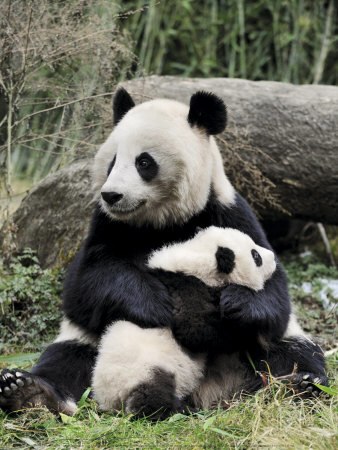
 Like the dragon of the past GIANT PANDA have become a national emblem for China.it belongs to the bear family and has a body shape typical of  bears.The Giant Pandas diet is 99% bamboo, 1% honey,eggs ,fish ,yams, shrub leaves , oranges and bananas. when available it's scientific name is Ailouropod  melanoeuca ( that means ' black and white cat - foot')The giant panda typically lives around 20 years in the wild and up to 30 years in captivity. The recorded age of the oldest captive giant panda, a female named Ming Ming, is 34The giant panda typically lives around 20 years in the wild and up to 30 years in captivity. The recorded age of the oldest captive giant panda, a female named Ming Ming, is 34.In the wild, the giant panda is a terrestrial animal  and primarily spends its life roaming and feeding in the bamboo forests of the Qin-ling Mountains and in the hilly Sichuan Province. Giant pandas are generally solitary, and each adult has a defined territory and females are not tolerant of other females in their range. Pandas communicate through vocalization and scent marking such as clawing trees or spraying urine. The giant panda is able to climb and take shelter in hollow trees or rock crevices but does not establish permanent dens. For this reason, pandas do not hibernate, which is similar to other subtropical mammals, and will instead move to elevations with warmer temperatures.Pandas rely primarily on spatial memory rather than visual memory.
Social encounters occur primarily during the brief breeding season in which pandas in proximity to one another will gather. After mating, the male leaves the female alone to raise the cub.


Kingdom:AnimaliaPhylum:ChordataClass:MammaliaOrder:CarnivoraFamily:UrsidaeGenus:AiluropodaSpecies:A. melanoleuca

Tailor Bird

Tailorbirds are small birds belonging to thThese warblers are usually brightly coloured, with green or grey upperparts and yellow white or grey underparts. They often have chestnut on the head.
Tailorbirds have short rounded wings, short tails, strong legs and long curved bills. The tail is typically held upright, like a wren.. They are typically found in open woodland, scrub and gardens.
Tailor birds get their name from the way their nest is constructed. The edges of a large leaf are pierced and sewn together with plant fiber or spider's web to make a cradle in which the actual grass nest is builte genus Orthotomus often placed in the Old World warbler family Sylviidae.

Species List

Two species have been found to be only distantly related to Orthotomus and probably better regarded as a separate genus Artisornis.[2]:
Plus the two species likely to be moved to the Cettiidae: