Friday, September 23, 2011

Siberian Husky


The Siberian Husky (Russian: Сибирский хаски, Sibirskiy haski, "Siberian husky") is a medium-size, dense-coat working dog breed that originated in eastern Siberia. The breed belongs to the Spitz genetic family. It is recognisable by its thickly furred double coat, sickle tail, erect triangular ears, and distinctive markings.
Huskies are an active, energetic, and resilient breed whose ancestors came from the extremely cold and harsh environment of the Siberian Arctic. Siberian Huskies were bred by the Chukchi of Northeastern Asia to pull heavy loads long distances through difficult conditions. The dogs were imported into Alaska during the Nome Gold Rush and later spread into the United States and Canada. They were initially sent to Alaska and Canada as sled dogs but rapidly acquired the status of family pets and show dogs.
Siberian Huskies share many outward similarities with the Alaskan Malamute as well as many other spitz breeds such as the Samoyed, which has a comparable history to the Huskies. They come in a variety of colors and patterns, usually with white paws and legs, facial markings, and tail tip. The most common coats are black and white, then less common copper-red and white, gray and white, pure white, and the rare "Agouti" coat, though many individuals have blondish or piebald spotting. Striking masks, spectacles, and other facial markings occur in wide variety. They tend to have a wolf-like appearance.
The breed standard indicates that the males of the breed are ideally between 21 and 23.5 inches (53 and 60 cm) tall at the withers and weighing between 45 and 60 pounds (20 and 27 kg). Females are smaller, growing to between 20 to 22 inches (51 to 56 cm) tThe Siberian Husky has been described as a behavioral representative of the domestic dog's forebear, the wolf, exhibiting a wide range of its ancestors' behavior. They are known to howl rather than bark. If the dog is well trained it can make a great family pet. The frequency of kenneled Siberian Huskies, especially for racing purposes, is rather high, as attributed through the history of the breed in North America. They are affectionate with people, but independent. A fifteen-minute daily obedience training class will serve well for Siberian Huskies. Siberians need consistent training and do well with a positive reinforcement training program. They rank 45th in Stanley Coren's The Intelligence of Dogs, being of average working/obedience intelligence. They tend to run because they were at first bred to be sled dogs. Owners are advised to exercise caution when letting their Siberian Husky off the leash as the dog could be miles away before looking around and realizing their owner is nowhere in sight. They are excellent "escape artists" as well and have been known to climb chain-link fences and find other ways of escaping a confined area. They also get bored easily, so playing with toys or throwing the ball at least once a day is essential. Failure to give them the attention or proper exercise they need can result in unwanted behavior, such as excessive howling, marking, chewing on furniture, or cryingall at the withers and weighing between 35 to 55 pounds (16 to 25 kg).
SIBERIAN HUSKY PUPS!
Siberian Huskies are highly intelligent, which allows them to excel in obedience trials, though many clubs would like to keep the Husky's instinct by doing sled-racing.However, because of their intelligence, they can easily become bored and may stop listening to commands. Many dog trainers usually attempt to avoid this behavior by keeping them busy with new activities. Also due in part to their intelligence, Huskies tend to be very observant on the actions of people around them and have been known to mimic common household activities such as turning on lights with their paws and opening doors with their canines. Some undesirable behaviors they can exhibit include opening refrigerators (and eating the food inside), climbing fences or digging tunnels in the backyard to escape.
Siberian Huskies, with proper care, have a typical lifespan ranging from twelve to fifteen years. Health issues in the breed are mainly genetic such as seizures and defects of the eye (juvenile cataracts, corneal dystrophy, and progressive retinal atrophy). Hip dysplasia is not often found in this breed; however, as with many medium or larger-sized canines, it can occur. The Orthopedic Foundation for Animals currently has the Siberian Husky ranked 148th out of a possible 153 breeds at risk for hip dysplasia, with only two percent of tested Siberian Huskies showing dysplasia.
THEY ARE USED AS SLED DIGS.
THIS PICTURE EXPLAINS ,AS IF THEY
ARE RESTING.
Siberian Huskies are still used as sled dogs in sled dog racing. Siberians are still popular in races restricted to purebreds and are faster than other pure sled dog breeds such as the Samoyed and the slower but much stronger Alaskan Malamute. Today the breed tends to divide along lines of "racing" Siberians and "show" Siberians. Racing Siberians tend to have more leg to enable them more reach when running. Show Siberians tend to be a bit smaller.
Apart from sled racing, they are very popular for recreational mushing and are also used for skijoring (one to three dogs pulling a skier) and European ski-hi. A few owners use them for dog-packing and hiking.

Wednesday, September 21, 2011

Canada Goose.

The Canada Goose (Branta canadensis) is a wild goose belonging to the genus Branta, which is native to arctic and temperate regions of North America, having a black head and neck, white patches on the face, and a brownish-gray body.
The Canada Goose was one of the many species described by Carl Linnaeus in his 18th-century work Systema Naturae. It belongs to theBranta genus of geese, which contains species with largely black plumage, distinguishing them from the grey species of the Anser genus. The specific epithet canadensis is a New Latin word meaning "from Canada". According to the Oxford English Dictionary, the first citation for the 'Canada Goose' dates back to 1772. The Cackling Goose was formerly considered to be a set of subspecies of the Canada Goose. The Canada Goose is also referred to as the Canadian Goose.
HERE ARE SOME CANADA GOOSE BREEDS.

  • Atlantic Canada Goose, Branta canadensis canadensis
  • Interior Canada Goose, Branta canadensis interior
  • Giant Canada Goose, Branta canadensis maxima
  • Moffitt's Canada Goose, Branta canadensis moffitti
  • Vancouver Canada Goose, Branta canadensis fulva
  • Dusky Canada Goose, Branta canadensis occidentalis
  • part of "Lesser complex", Branta canadensis parvipe
The black head and neck with white "chinstrap" distinguish the Canada Goose from all other goose species, with the exception of the Barnacle Goose, but the latter has a black breast, and also grey, rather than brownish, body plumage.There are seven subspecies of this bird, of varying sizes and plumage details, but all are recognizable as Canada Geese. Some of the smaller races can be hard to distinguish from the newly-separated Cackling Goose.
This species is native to North America. It breeds in Canada and thenorthern United States in a variety of habitats. Its nest is usually located in an elevated area near water such as streams, lakes, ponds and sometimes on a beaver lodge. Its eggs are laid in a shallow depression lined with plant material and down. The Great Lakes region maintains a very large population of Canada Geese.
FLYING V- SHAPE,SEE THE BEAUTY!
Like most geese, the Canada Goose is naturally migratory with the wintering range being most of the United States. The calls overhead from large groups of Canada Geese flying in V-shaped formation signal the transitions into spring and autumn. In some areas, migration routes have changed due to changes in habitat and food sources. In mild climates from California to the Great Lakes, some of the population has become non-migratory due to adequate winter food supply and a lack of former predators
Canada Geese are primarily herbivores, although they sometimes eat small insects and fish. Their diet includes green vegetation and grains. The Canada Goose eats a variety of grasses when on land. It feeds by grasping a blade of grass with the bill, then tearing it with a jerk of the head. The Canada Goose also eats grains such as wheat, beans, rice, and corn when they are available.

During the second year of their lives, Canada Geese find a mate. They are monogamous, and most couples stay together all of their lives.If one is killed, the other may find a new mate. The female lays 3–8 eggs and both parents protect the nest while the eggs incubate, but the female spends more time at the nest than the male.[
Known egg predators include coyotes, Arctic Foxes, Northern Raccoons, Red Foxes, large gulls, Common Raven, American Crows and bears.
BABIES SWIMMING CLOSE TO
THEIR MOTHER.
The incubation period, in which the female incubates while the male remains nearby, lasts for 24–28 days after laying. As the annual summer molt also takes place during the breeding season, the adults lose their flight feathers for 20–40 days, regaining flight at about the same time as their goslings start to fly.
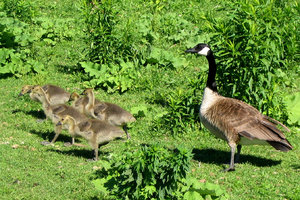
HAVING A WALK .
Adult geese are often seen leading their goslings in a line, usually with one parent at the front, and the other at the back. While protecting their goslings, parents often violently chase away nearby creatures, from small blackbirds to lone humans that approach, after warning them by giving off a hissing sound and will then attack with bites and slaps of the wings if the threat does not retreat or has seized a gosling. Most of the species that prey on eggs will also take a gosling. Although parents are hostile to unfamiliar geese, they may form groups of a number of goslings and a few adults, called crèches.
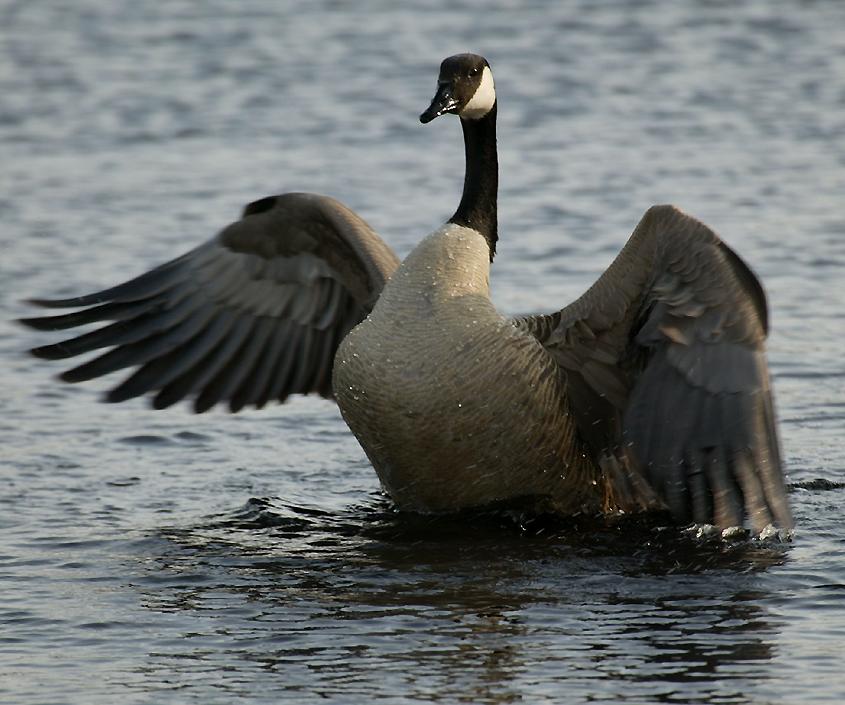
RESTING IN A POND DURING
SPRING MIGRATION!
The offspring enter the fledging stage any time from 6 to 9 weeks of age. They do not leave their parents until after the spring migration, when they return to their birthplace. Once they reach adulthood, Canada Geese are rarely preyed on, but (beyond humans) can be taken by Coyotes, Red Foxes, Gray Wolves, Snowy Owls, Great Horned Owls, Golden Eagles and, most often, Bald Eagles.
Canada geese are known for their seasonal migrations. Most Canada Geese have staging or resting areas where they join up with others. Their autumn migration can be seen from September to the beginning of November. The early migrants have a tendency to spend less time at rest stops and go through the migration a lot faster. The later birds usually spend more time at rest stops. These geese are also renowned for their V-shaped flight formation. The front position is rotated since flying in front consumes the most energy. Canada Geese leave the winter grounds more quickly than the summer grounds. Elevated thyroid hormones, such as T3 and T4, have been measured in geese just after a big migration. This is believed because of the long days of flying in migration the thyroid gland sends out more T4 which will help the body cope with the longer journey. The increased T4 levels are also associated with increased muscle mass (hypertrophy) of the breast muscle, also because of the longer time spent flying. It is believed that the body sends out more T4 to help the goose's body with this long task by speeding up the metabolism and temperature at which the body works.Also, other studies done show corticosterone levels to rise dramatically in these birds after and during a migration. Corticosterone is known a stress hormone, so it only makes sense that when these birds are stressed by flying long distances everyday, that more corticosterone is released into their system. It is believed that a higher level of corticosterone will help the birds better manage this task.

Sunday, September 18, 2011

Maine Coon Cats

MAINE COON SILVER TABBY IN THE
SNOW.

The Maine Coon is a breed of domestic cat with a distinctive physical appearance and valuable hunting skills. It is one of the oldest natural breeds in North America, specifically native to the state of Maine, where it is the official State Cat.
Although the Maine Coon's exact origins and date of introduction to the United States are unknown, many theories have been proposed. The breed was popular in cat shows in the late 19th century, but its existence became threatened when long-haired breeds from overseas were introduced in the early 20th century. The Maine Coon has since made a comeback and is now one of the most popular cat breeds in the world.
Maine Coons are one of the largest breeds of domestic cat. Males weigh from 15 to 25 lb (6.8 to 11 kg) with females weighing from 10 to 15 lb (4.5 to 6.8 kg). The height of adults can vary between 10 and 16 in (25 and 41 cm) and they can reach a length of up to 40 in (100 cm), including the tail, which can reach a length of 14 in (36 cm and is long, tapering, and heavily furred, almost resembling a raccoon's tail. The body is solid and muscular, which is necessary for supporting their own weight, and the chest is broad. Maine Coons possess a rectangular body shape and are slow to physically mature; their full potential size is normally not reached until they are three to five years old, while other cats take about only one year.
The Maine Coon is noted for its large bone structure, rectangular body shape, and long, flowing coat. The breed can be seen in a variety of colors and is known for its intelligence and gentle personality Health problems, such as feline hypertrophic cardiomyopathy and hip dysplasia, are seen in the breed, but screening methods can help to reduce the frequency of these problems.
In 2010, the Guinness World Records accepted a male purebred Maine Coon named "Stewie" as the "Longest Cat" measuring 48.5 in (123 cm) from the tip of his nose to the tip of histail.
WHITE MAINE COONS! THEY
ARE VERY NICE.
MAINE COON KITTEN.
The Maine Coon is a longhaired, or medium-haired, cat. The coat is soft and silky, although texture may vary with coat color. The length is shorter on the head and shoulders, and longer on the stomach and flanks with some cats having a lion-like ruff around their neck. Minimal grooming is required for the breed, compared to other long-haired breeds, as their coat is mostly self-maintaining due to a light-density undercoat. The coat is subject to seasonal variation, with the fur being thicker in the winter and thinner during the summer. Maine Coons, due to their large size, have larger claws. There have been cases of Maine Coons using their claws to grip into walls.
Maine Coons are generally a healthy and hardy breed and have evolved to survive the New England climate. The most severe threat is feline hypertrophic cardiomyopathy (HCM), the most common heart disease seen in cats, whether pure bred or not. In Maine Coons, it is thought to be inherited as an autosomal dominant trait. Middle-aged to older cats as well as males are thought to be predisposed to the disease.HCM is a progressive disease and can result in heart failure, paralysis of the hind legs due to clot embolization originating in the heart, and sudden death. A specific mutation that causes HCM is seen in Maine Coons for which testing services are offered. Of all the Maine Coons tested for the MyBPC mutation at the Veterinary Cardiac Genetics Lab at the College of Veterinary Medicine located at Washington State University, approximately one-third tested positive. Not all cats that tested positive will have clinical signs of the disease and some Maine Coon cats with clinical evidence of hypertrophic cardiomyopathy test negative for this mutation, strongly suggesting that a second mutation exists in the breed. Ultrasound of the heart (echocardiogram) is thought to be a more reliable method for weeding HCM out of the Maine Coon population.

Doberman Pinscher


BLUE, BLACK AND BROWN
DOBERMAN'S (PINSCHER) ARE THEIR,AS WELL AS
WHITE TOO.

The Doberman Pinscher (alternatively spelled Dobermann in many countries) or simply Doberman, is a breed of domestic dog originally developed around 1890 by Karl Friedrich Louis Dobermann. Dobermann Pinschers are among the most common of pet breeds, and the breed is well known as an intelligent, alert, and loyal companion dog. Although once commonly used as guard dogs or police dogs, this is less common today.
Kennel club standards describe Doberman Pinschers as dogs of medium size with a square build and short coat. They are compactly built and athletic with endurance and speed. The Doberman Pinscher should have a proud, watchful, determined, and obedient temperament.The dog was originally intended as a guard dog, so males should have a masculine, muscular, noble appearance. Females are thinner, but should not be spindly Two different color genes exist in the Doberman, one for black. There are nine possible combinations of these alleles , which result in four different color phenotypes: black, red, blue, and fawn (Isabella).The traditional and most common color occurs when both the color and dilution genes have at least one dominant allele , and is commonly referred to as black or black and rust (also called black and tan). The red, red rust or browncoloration occurs when the black gene has two recessive alleles but the dilution gene has at least one dominant allele . "Blue" and "fawn" are controlled by the color dilution gene. The blue Doberman has the color gene with at least one dominant allele and the dilution gene with both recessive alleles . The fawn (Isabella) coloration is the least common, occurring only when both the color and dilution genes have two recessive alleles . Thus, the blue color is a diluted black, and the fawn color is a diluted redThe Doberman Pinscher's natural tail is fairly long, but individual dogs often have a short tail as a result of docking, a procedure in which the majority of the tail is surgically removed shortly after birth.
THE TAILS ARE VERY SHORT
In many countries, Dobermann Pinschers are one of the most recognizable breeds, in part because of their actual roles in society, and in part because of media attention (see temperament). Careful breeding has improved the disposition of this breed, and the modern Dobermann Pinscher is an energetic and lively breed suitable for companionship and family life.
The practice of docking has been around for centuries, and is older than the Doberman as a breed. The putative reason for docking is to ensure that the tail does not get in the way of the dog's work. Docking has always been controversial. The American Kennel Club standard for Doberman Pinschers includes a tail docked near the 2nd vertebra. Docking is a common practice in North America, Russia and Japan (as well as a number of other countries with Doberman populations), where it is legal. In many European countries, docking has been made illegal, and in others it is limited.
Although they are considered to be working dogs, Doberman Pinschers are the target of a stereotype of ferocity and aggression. As a personal protection dog, the Doberman was originally bred for these traits: it had to be large and intimidating, fearless and willing to defend its owner, but sufficiently obedient and restrained to only do so on command.These traits served the dog well in its role as a personal defense dog, police dog or war dog, but were not ideally adapted to a companionship role. In recent decades, the Doberman Pinscher's size, short coat, and intelligence made it a desirable house dog. Although these dogs are known for their aggression, they are also extremely loyal. They can easily learn to 'Respect and Protect' their owners.
In response, they are excellent guard dogs that protect their loved ones. They are generally sociable towards humans and can be with other dogs, ranking among the more-likely breeds to show aggressive behaviour toward strangers and other dogs but not among the most likely. They are very unlikely to show aggressive behaviour towards their owners, an unlikely behaviour that can only be allowed to grow up in the puppy if the owner doesn't have previous dog experience. 
WHITE DOBERMANS ARE  ALSO
THEIR!
DOBERMAN PINSCHER PUPS.
There is evidence that Doberman Pinschers in North America are calmer than their European counterparts because of these breeding strategies. Because of these differences in breeding strategies, different lines of Doberman Pinschers have developed different traits. Although many contemporary Doberman Pinschers in North America are gentle, loyal, loving, and intelligent dogs, some lines are bred more true to the original personality standard.
Canine intelligence is an umbrella term that encompasses the faculties involved in a wide range of mental tasks, such as learning, problem-solving, and communication. The Doberman Pinscher has ranked amongst the most intelligent of dog breeds in experimental studies and expert evaluations. For instance, Psychologist Stanley Coren ranks the Doberman as the 5th most intelligent dog in the category of obedience command training, based on the selective surveys he performed of some trainers (as documented in his book The Intelligence of Dogs). Additionally, in two studies, Hart and Hart (1985) ranked the Doberman Pinscher first in this category. and Tortora (1980) gave the Doberman the highest rank in train ability,. Although the methods of evaluation differ, these studies consistently show that the Doberman Pinscher, along with the Border Collie, German Shepherd and Standard Poodle, is one of the most trainable breeds of dog.

Thursday, September 15, 2011

Lady Birds (Coccinellidae)


Coccinellidae is a family of beetles, known variously as ladybirds (UK, Ireland, Australia, Sri Lanka, Pakistan, South Africa, New Zealand, India, Malta, some parts of Canada and the US), or ladybugs (North America). Scientists increasingly prefer the namesladybird beetles or lady beetles as these insects are not true bugs. Lesser-used names include God's cow, ladyclock, lady cow, and lady fly.
Coccinellids are small insects, ranging from 1 mm to 10 mm (0.04 to 0.4 inches), and are commonly yellow, orange, or scarlet with small black spots on their wing covers, with black legs, head and antennae. A very large number of coccinellid species are mostly, or entirely, black, grey, or brown and may be difficult for non-entomologists to recognize as coccinellids. Conversely, there are many small beetles that are easily mistaken for coccinellids, such as the tortoise beetles.
Coccinellids are found worldwide, with over 5,000 species described more than 450 native to North America alone.
PARTS OF LADYBIRDS.
A few species are considered pests in North America and Europe, but they are generally considered useful insects as many species feed on aphids or scale insects, which are pests in gardens, agricultural fields, orchards, and similar places. Harmonia axyridis (or the Harlequin ladybug) was introduced into North America from Asia in 1988 to control aphids but is now the most common species as it is out-competing many of the native species. It has since spread to much of western Europe, reaching the UK in 2004.
A common myth is that the number of spots on the insect's back indicates its age.
The name "ladybird" originated in Britain where the insects became known as "Our Lady's bird" or the "Lady beetle".Mary (Our Lady) was often depicted wearing a red cloak in early paintings and the spots of the seven spot ladybird (the most common in Europe) were said to symbolise her seven joys and seven sorrows. In the United States the name was adapted to "ladybug".
Common names in other European languages have the same association (the German name Marienkäfer translates to "Marybeetle" or, literally, Mary-chafer).
A HUGE GROUP OF LADY BIRDS
CLIMBING A BROKEN TREE.
SEE HOW THEY ARE LIVING IN
PEACE.
The Dutch name "Lieveheersbeestje" and the colloquial French name "Bête à bon Dieu" mean "Our Lord's animal". The name "God's cow" is a literal translation from Irish "Boin Dé", which is probably a corruption of the French name.
In the United States, Coccinellids usually begin to appear indoors in the fall. They leave their summer feeding sites in fields, forests and yards looking for a place to spend the winter. Typically when temperatures warm to the mid-60s Fahrenheit in the late afternoon, following a period of cooler weather, they will swarm onto or into buildings illuminated by the sun. Swarms of Coccinellids fly to buildings in September through November depending on location and weather conditions. Also, homes or buildings near fields or woods are more prone to infestation.
COLORFUL LADY BIRDS.
The presence of Coccinellids in grape harvests can cause ladybird taint in wines produced from the grapes.
After an abnormally long period of hot dry weather in the Summer of 1976 in the UK, there was a marked increase in the aphid population followed by a "plague" of Coccinellids, with many reports of people being bitten as the supply of aphids dwindled.Recent studies suggest that Coccinellids can also cause allergic reactions, such as eye irritation or asthma.
The ladybird was immortalized in the still-popular children's nursery rhyme Ladybird, Ladybird:
Ladybird, ladybird, fly away home
Your house is on fire and your children are gone
All except one, and that's Little Anne
For she has crept under the warming pan

Arabian Horses


The Arabian or Arab horse (Arabic: الحصان العربي ‎ [ ħisˤaːn ʕarabiː], DMG ḥiṣān ʿarabī) is a breed of horse that originated on the Arabian Peninsula. With a distinctive head shape and high tail carriage, the Arabian is one of the most easily recognizable horse breeds in the world. It is also one of the oldest breeds, with archaeological evidence of horses that resemble modern Arabians dating back 4,500 years. Throughout history, Arabian horses spread around the world by both war and trade, used to improve other breeds by adding speed, refinement, endurance, and strong bone. Today, Arabian bloodlines are found in almost every modern breed of riding horse.
The Arabian developed in a desert climate and was prized by the nomadic Bedouin people, often being brought inside the family tent for shelter and protection from theft. Selective breeding for traits including an ability to form a cooperative relationship with humans created a horse breed that is good-natured, quick to learn, and willing to please. The Arabian also developed the high spirit and alertness needed in a horse used for raiding and war. This combination of willingness and sensitivity requires modern Arabian horse owners to handle their horses with competence and respect.
Arabian horses have refined, wedge-shaped heads, a broad forehead, large eyes, large nostrils, and small muzzles. Most display a distinctive concave or "dished" profile. Many Arabians also have a slight forehead bulge between their eyes, called the jibbahby the Bedouin, that adds additional sinus capacity, believed to have helped the Arabian horse in its native dry desert climate. Another breed characteristic is an arched neck with a large, well-set windpipe set on a refined, clean throatlatch. This structure of the poll and throatlatch was called the mitbah or mitbeh by the Bedouin. In the best Arabians it is long, allowing flexibility in the bridle and room for the windpipe.
AN ARABIAN FOAL NEAR TO
IT'S MOTHER, CAUSE OF DANGER.

The Arabian is a versatile breed. Arabians dominate the discipline of endurance riding, and compete today in many other fields of equestrianactivity. They are one of the top ten most popular horse breeds in the world. They are now found worldwide, including the United States and Canada, the United Kingdom, Australia, continental Europe, South America (especially Brazil), and its land of origin, the Middle East.The breed standard stated by the United States Equestrian Federation, describes Arabians as standing between 14.1 to 15.1 hands (57 to 61 inches, 145 to 155 cm) tall, "with the occasional individual over or under." Thus, all Arabians, regardless of height, are classified as "horses", even though 14.2 hands (58 inches, 147 cm) is the traditional cutoff height between a horse and a pony. A common myth is that Arabians are not strong because they are relatively small and refined. However, the Arabian horse is noted for a greater density of bone than other breeds, short cannons, sound feet, and a broad, short back,all of which give the breed physical strength comparable to many taller animals.Thus, even a smaller Arabian can carry a heavy rider. For tasks where the sheer weight of the horse matters, such as farm work done by a draft horse, any lighter-weight horse is at a disadvantage. However, for most purposes, the Arabian is a strong and hardy light horse breed able to carry any type of rider in most equestrian pursuits.For centuries, Arabian horses lived in the desert in close association with humans.For shelter and protection from theft, prized war mareswere sometimes kept in their owner's tent, close to children and everyday family life. Only horses with a naturally good disposition were allowed to reproduce, with the result that Arabians today have a good temperament that, among other examples, makes them one of the few breeds where the United States Equestrian Federation rules allow children to exhibit stallions in nearly all show ring classes, including those limited to riders under 18.
Other distinctive features are a relatively long, level croup, or top of the hindquarters, and naturally high tail carriage. The USEF breed standard requires Arabians have solid bone and standard correct equine conformation. Well-bred Arabians have a deep, well-angled hip and well laid-back shoulder. Within the breed, there are variations. Some individuals have wider, more powerfully muscled hindquarters suitable for intense bursts of activity in events such as reining, while others have longer, leaner muscling better suited for long stretches of flat work such as endurance riding or horse racing. Most have a compact body with a short back. Arabians usually have dense, strong bone, and good hoof walls. They are especially noted for their endurance, and the superiority of the breed in Endurance riding competition demonstrates that well-bred Arabians are strong, sound horses with superior stamina. At international FEI-sponsored endurance events, Arabians and half-Arabians are the dominant performers in distance competition.
The Arabian Horse Association registers purebred horses with the coat colors bay, gray, chestnut, black, and roan.Bay, gray and chestnut are the most common, black is less common. The classic roan gene does not appear to exist in Arabians;rather, Arabians registered by breeders as "roan" are usually expressing rabicano or, sometimes, sabino patterns with roan features.All Arabians, no matter their coat color, have black skin, except under white markings. Black skin provided protection from the intense desert sun.
THEIR ARE VARIOUS TYPES OF
COLORS AND THEY HAVE NICE
COLORS TOO.
Purebred Arabians never carry dilution genes. Therefore, purebreds cannot be colors such as dun, cremello, palomino or buckskin.However, there is pictorial evidence from pottery and tombs in Ancient Egypt suggesting that spotting patterns may have existed on ancestral Arabian-type horses in antiquity.Nonetheless, purebred Arabians today do not carry genes for pinto or Appaloosa spotting patterns, except for sabino.
Spotting or excess white was believed by many breeders to be a mark of impurity until DNA testing for verification of parentage became standard. For a time, horses with belly spots and other white markings deemed excessive were discouraged from registration and excess white was sometimes penalized in the show ring.
Arabians are versatile horses that compete in many equestrian fields, including horse racing, the horse show disciplines of saddle seat, Western pleasure, and hunt seat, as well asdressage, cutting, reining, endurance riding, show jumping, even ting, youth events such as equitation, and others. They are used as pleasure riding, trail riding, and working ranch horses for those who are not interested in competition.
WHITE ARABIAN STALLION.

Afghan Hounds

AFGHAN HOUND WITH IT'S PUP.
The Afghan Hound is one of the oldest sighthound dog breeds. Distinguished by its thick, fine, silky coat and its tail with a ring curl at the end, the breed acquired its unique features in the cold mountains of Afghanistan, where it was originally used to hunthares and gazelles by coursing them. Its local name is Sag-e Tāzī (Persian: سگ تازی) or Tāžī Spai (Pashto: تاژي سپی). Other alternate names for this breed are Kuchi Hound, Tāzī, Balkh Hound, Baluchi Hound, Barutzy Hound, Shalgar Hound, Kabul Hound,Galanday Hound, or sometimes incorrectly African Hound.The Afghan Hound is tall, standing in height 24-29 inches and weighing 45-60 pounds. The coat may be any colour, but white markings, particularly on the head, are discouraged; many individuals have a black facial mask. Some specimens have facial hair that looks like a Fu Manchu moustache that are called "mandarins." Some Afghan Hounds are almost white, but particolour hounds (white with islands of red or black) are not acceptable and may indicate impure breeding. The long, fine-textured coat requires considerable care and grooming. The long topknot and the shorter-haired saddle on the back in the miniature dog are distinctive features of the Afghan Hound coat. The high hipbones and unique small ring on the end of the tail are also characteristics of the breed.A tall hunting dog of a breed with long silky hair.
DRAWING OF AN AFGHAN
HOUND.SEE HOW BEAU-TI
-FUL
The temperament of the typical Afghan Hound can be aloof and dignified, but happy and clownish when playing. This breed, as is the case with many sighthounds, has a high prey drive and may not get along with small animals. The Afghan Hounds' reasoning skills have made it a successful competitor in dog agility trials as well as an intuitive therapy dog and companion. Genomic studies have pointed to the Afghan Hound as one of the oldest of dog breeds.
The breed has a reputation among some dog trainers of having a relatively slow "obedience intelligence" as defined by author Stanley Coren.
Although seldom used today for hunting in Europe and America where they are popular, Afghan hounds are frequent participants in lure coursing events and are also popular in the sport of conformation showing.
Other namesSage Baluchi, Tazhi Spai, De Kochyano Spai, Tazi, Ogar Afgan, Eastern Greyhound/Persian Greyhound
Country of originAfghanistan
]Traits
WeightMale20–27 kg (45–60 lb)
HeightMale61–73 cm (24–29 in)
CoatLong and fine
ColorFawn,Gold,Brindle,White,Red,Cream,Blue,Gray,and Tricolor
Litter size6–8 puppies
Life span11–13 years
Afghan Hounds in UK surveys had a median lifespan of about 12 years and 18 years if the dog is taken care of,[3] which is similar to other breeds of their size. In a 2004 UK Kennel Club survey, the most common causes of death were cancer (31%), old age (20%), cardiac (10.5%), and urologic (5%).