Friday, February 6, 2015

SCOTTISH DEERHOUND

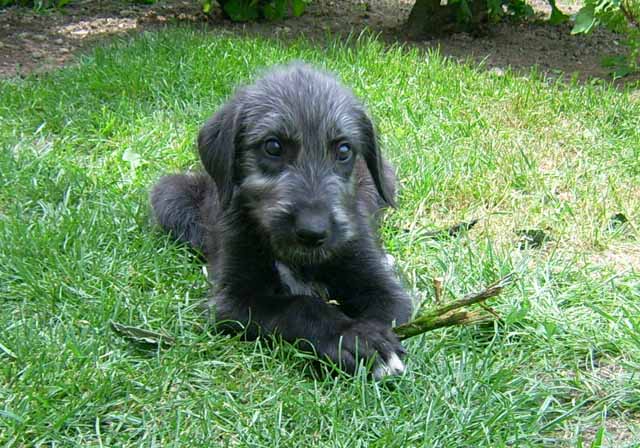
The Scottish Deerhound, or simply the Deerhound, is a large breed of hound (a sighthound), once bred to hunt the Red Deer by coursing.The Scottish Deerhound resembles a rough-coated Greyhound. It is however, larger in size and bone. Height of males from 30 to 32 inches (75–80 cm) or more, weight 85 to 110 pounds (40–50 kg); height of females from 28 inches (70 cm) upwards, weight from 75 to 95 pounds (35–43 kg). It is one of the tallest sighthounds, with a harsh 3-4 inch long coat and mane, somewhat softer beard and moustache, and softer hair on breast and belly. It has small, dark "rose" ears which are soft and folded back against the head unless held semi-erect in excitement. The harsh, wiry coat in modern dogs is only seen in self-coloured various shades of gray (blue-gray is preferred). Historically, Deerhounds also could be seen with true brindle, yellow, and red fawn coats, or combinations. 19th century Scottish paintings tend to indicate these colours were associated with a wire haired coat, but, with show breeders preferring a longer coat, these genes now appear to be lost. A white chest and toes are allowed, and a slight white tip to the tail; a white blaze on the head or a white collar are not accepted. The head is long, skull flat, with little stop and a tapering muzzle. The eyes are dark, dark brown or hazel in colour. The teeth should form a level, complete scissor bite. The long straight or curved tail, well covered with hair, should almost reach the ground.

THIS IS A SCOTTISH DEER HOUND PUP
The Scottish Deerhound is gentle and extremely friendly. The breed is famed for being docile and eager to please, with a bearing of gentle dignity. It is however a true sighthound which has been selected for generations to pursue game; consequently, most Deerhounds will be eager to chase. The Deerhound needs considerable exercise when young to develop properly and to maintain its health and condition. That does not mean it needs a large house to live in; however it should have regular access to free exercise in a fenced or otherwise "safe" area. Deerhounds should not be raised with access only to leash walking or a small yard, this would be detrimental to their health and development. City dwellers with conviction, however, can keep the dog both healthy and happy, as long as they are willing to take their Deerhounds to nearby parks for lengthy runs and rigorous fetching sessions within these wider running courses. Young Deerhounds can sometimes, depending on the individual, be quite destructive especially when they are not given sufficient exercise; however, the average adult Deerhound may want to spend most of the day stretched out on the floor or a couch sleeping. They do require a stimulus, preferably another Deerhound, and a large area to exercise properly and frequently. They are gentle and docile indoors and are generally good around company and children (however, due to their size, they require supervision with young children).
THEY ARE SO GOOD COMPANIONS
Scottish Deerhounds live an average of 8 1/2 to 9 years. The serious health issues in the breed include cardiomyopathyosteosarcoma; bloat; stomach or splenic torsion, called Gastric dilatation volvulus; and cystinuriaScottish Deerhounds compete throughout USA in conformation and lure coursing, in states where it is legal, they are used in hare coursingand for coyote hunting. Deerhounds can compete in obedience though few excel in it. Fewer still excel in dog agility or flyball because these competitions favor smaller dogs with lower body weight and a much shorter stride.At one point in history, no one of rank lower than an earl might possess a Scottish Deerhound; the breed almost became extinct because of these policies.


SIND SPARROW

The Sind sparrow (Passer pyrrhonotus) is a passerine bird of the sparrow family Passeridae, found around the Indus valley region inSouth Asia. It is also known as the jungleSind jungle, or rufous-backed sparrow. Very similar to the related house sparrow, it is smaller and has distinguishing plumage features. As in the house sparrow, the male has brighter plumage than female and young birds, including black markings and a grey crown. Distinctively, the male has a chestnut stripe running down its head behind the eye, and the female has a darker head than other sparrow species do. Its main vocalisations are soft chirping calls that are extended into longer songs with other sounds interspersed by breeding males. Historically, this species was thought to be very closely related to the house sparrow, but its closest evolutionary affinities may lie elsewhere. Discovered around 1840, this species went undetected for several decades after its discovery.

THIS IS A DRAWING OF A PAIR OF
SIND SPARROWS
The Sind sparrow is very similar to the house sparrow, and both sexes resemble their counterparts of that species, but it is slightly smaller and males and females each have features that distinguish them as Sind sparrows. The Sind sparrow is 13 cm (5.1 in) long, while the common South Asian subspecies of the house sparrow, Passer domesticus indicus, is about 15 cm (5.9 in) long. Wingspans range from 6.2 to 7.0 cm (2.4 to 2.8 in), tails from 4.7 to 5.7 cm (1.9 to 2.2 in), and tarsi measure 1.6–1.9 centimetres (0.63–0.75 in).The male has a short and narrow black bib and a broad chestnut eye stripe that does not meet the mantle. The male has a grey crown and nape and a rufous lower back and rump. The female has a darker and greyer crown and cheek than the female house sparrow and the shoulder is darker chestnut. The female Dead Sea sparrow of the subspecies Passer moabiticus yattii is also similar to the female Sind sparrow, but has yellow tinges on the underparts and sometimes on parts of the head. The bill is black on the breeding male and pale brown on the non-breeding male and female. With a culmen length of 1.1–1.3 centimetres (0.43–0.51 in), the Sind sparrow is slightly smaller-billed than the house sparrow.The Sind sparrow's chirping chup call is softer, less strident, and higher pitched than that of the house sparrow, and is easily distinguished. The song of males includes chirrups interspersed with grating t-r-r-rt notes and short warbles or whistles.
The Sind sparrow has a restricted distribution, primarily occurring within the Indus valley of Pakistan, and the lower parts of the tributaries of the Indus in the Punjab region. The Sind sparrow is somewhat common in its restricted breeding range,and no threats are known to the survival of the species, so it is assessed as least concern on the IUCN Red List.During winter, it often makes short distance movements.

It mostly breeds in acacia and tamarisk scrub and tall grass, invariably near rivers or other wetlands. The construction and expansion of irrigation canals has increased its habitat in Sindh, and helped it extend its range into the Yamuna floodplain and parts of Rajasthan, India. It may breed around rice paddies and other fields, or human habitations, provided that there is enough cover and suitable nesting sites. In winter, it moves away from its main riverine habitat, and into drier thickets characterised by Salvadora and Capparis bushes, but never moves too far from water.
THIS IS A CLOSER VIEW OF A SIND SPARROW.
The Sind sparrow is gregarious, generally forming small groups of four to six birds while feeding. It tends to breed in loose colonies of a few pairs, and non-breeding birds may gather to roost in acacias or tamarisks near water. During winter, the non-breeding season, it forms larger flocks of as many as 30 birds, and joins flocks with other seed-eating birds, such as house sparrows and red avadavats. The Sind sparrow feeds mainly on the seeds of grasses and other plants such as Polygonum plebeium. It may also forage for insects such as caterpillars, especially to feed nestlings. Flocks forage on flats alongside rivers, flying into nearby bushes and continuing to forage when disturbed.Nesting occurs during a period of several months between April to September, the timing depending on rainfall, during which two clutches are raised by most pairs. Sind sparrows build nests in the upper branches of thorny trees or the ends of thin branches hanging over water.

Tuesday, February 3, 2015

CANAAN

Canaan dog,is a breed of pariah dog, and has been part of the Middle Eastern landscape for thousands of years. It may have existed in the eastern Mediterranean seaboard for millennia, as referenced in ancient carvings and drawings. There are 2,000 to 3,000 Canaan dogs across the world, mostly in Europe and North America.It is also the national dog of Israel.The Canaan dog began in ancient times as a primitive feral in ancient Canaan, where the Canaanites and Israelites lived, roughly corresponding to the region encompassing modern-day IsraelLebanon, and the western parts of Jordan., Palestine

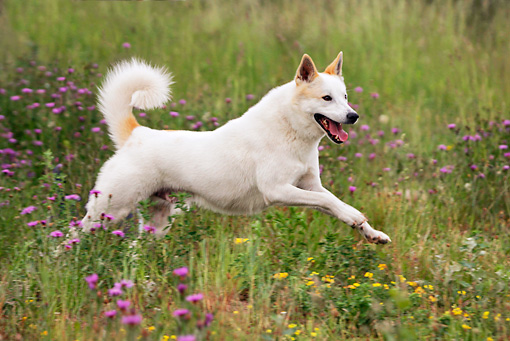
THIS IS A CANAAN DOG RUNNING IN A FIELD OF FLOWERS
The Canaan dog is a typical primitive dog in appearance. It is a medium-sized square built dog, with a wedge-shaped head, erect and low set ears with a broad base and rounded tips. Its outer coat is dense, harsh and straight of short to medium-length. The undercoat should be close and profuse according to season. Color ranges from black to cream and all shades of brown and red between, usually with small white markings, or all white with colour patches. Spotting of all kinds is permitted, as well as white or black masks.Rudolphina Menzel, an immigrant to Mandate Palestine from Austria, having studied the desert free living dogs and the variations in appearances, classified these canines into four types: 1) heavy, sheepdog appearance, 2) dingo-like appearance, 3) Border Collie appearance, 4) Greyhound appearance.Type varies somewhat between the lines of other Canaan dogs and those found in Israel and the rest of the world.


THIS BREED LOVES CHILDREN!
Canaan dogs have a strong survival instinct. They are quick to react and wary of strangers, and will alert to any disturbances with prompt barking, thus making them excellent watchdogs. Though defensive, they are not aggressive and are very good with children within the family, but may be wary of other children or defensive when your child is playing with another child. They are intelligent and learn quickly, but may get bored with repetitive exercises or ignore commands if they find something of more interest.Canaan Dogs can compete in dog agility trials, obedienceshowmanshipflyballtracking, and herding events. Herding instincts and trainability can be measured at noncompetitive herding tests. Canaans exhibiting basic herding instincts can be trained to compete in herding trials.

Sunday, January 11, 2015

ARABIAN MA

The Arabian Mau is a formal breed of domestic cat, originated from the desert cat, a short-haired landrace native to the desert of the Arabian Peninsula, which lives there in the streets and has adapted very well to the extreme climate. The Arabian Mau is recognized as a formal breed by few fancier and breeder organization and cat registryWorld Cat Federation (WCF) and Middle East Cat Society (MECATS). Based on one landrace, the Arabian Mau it is a natural breed.

REALLY PRETTY CATS
It is medium in size, with a body structure that is rather large and firm, not particularly slender, and with well developed musculature. The legs are comparatively long, with oval paws.The head appears round, but is slightly longer than broad. The nose is slightly concave curved, when viewed in profile. The whisker pads are clearly pronounced, with a slight pinch. The chin is very firm. The eyes are slightly oval, large and slightly slanted. The cat may have any normal cat eye colour, and there is no relation between the eye and coat colors, usually Arabian Maus have bright green eyes. The ears are large, slightly forward and sideward-placed, high-set on the skull.[1]The tail is generally of medium length and tapers slightly towards the tip.The coat is short and lying close to the body. It has no undercoat and is firm to touch. It may not be silky, but is noticeably very glossy.
THIS IS A BROWN ARABIAN MAU
The desert cat has been a landrace native to KuwaitQatarSaudi Arabia, and the United Arab Emirates for more than 1,000 years. Desert cats are well adapted to the hot, Middle Eastern environmentGenerally Arabian Mau cats have very loving temperaments. The main feature of this cat breed is their devotion, love and affection for the owner. This cat will always be a reliable companion of an individual that loves his cat and cares for it. Arabian Mau gets along very well with children and different kinds of animals. These cats are neat and take care of themselves very well.Arabian Mau cats were adapted to a desert life style and had to hunt for food themselves; possibly because of this they are not picky about food and they seem to love eating. They like to play and so this breed is very active and curious. They are good hunters, quick and agile. Cats that are allowed to go outdoors, will easily catch a prey and bring it back home. These cats easily jump and jump high. Outdoor cats like to walk around their territory and their house; Arabian Mau are very territorial breed. Males always guard their territory from other male cats.
SOME ARABIAN MAU  KITTENS BUT DIFFERENT
COLOUR
Females are medium sized and elegant; however, males can be very huge. They have muscular bodies though females are slightly smaller. Their legs are long with perfectly oval paws. They have large ears. The tail has medium length with tapering toward the tip. The head appears to be round, but it is slightly longer than broad with well-defined whisker pads. Ears are large and well set. Their eyes are oval and match the coat color. The fur is short and without any undercoat; besides it lying close enough to the body. The coat should not be silky. The colors can be different but the most recognized are red, white, black, black and white, brown and brown tabby..Arabian Mau breed has good health. Kittens are born strong and healthy, as the Arabian Mau cats have a good immune system. Both pedigreed cats and mixed-breed cats have varying incidences of health problems that may be genetic in nature. Arabian Mau's are generally healthy cats, as they are a natural breed.

Saturday, January 10, 2015

DANDIE DINMONT TERRIER

Dandie Dinmont Terrier is a small Scottish breed of dog in the terrier family. The breed has a very long body, short legs, and a distinctive "top-knot" of hair on the head. A character in Sir Walter Scott's novel Guy Mannering has lent the name to the breed, with "Dandie Dinmont" thought to be based on James Davidson, who is credited as being the "father" of the modern breed. Davidson's dogs descended from earlier terrier owning families, including the Allans of Holystone, Northumberland.There are three breed clubs in the UK supporting the breed, although it is registered as a Vulnerable Native Breed by the Kennel Club due to its low number of puppy registrations on a yearly basis. The breed is friendly, but tough and is suitable for interaction with older children. There are no breed specific health concerns, but they can be affected by spinal issues due to their elongated body and the breed is affected by canine cancer at a higher than average rate.
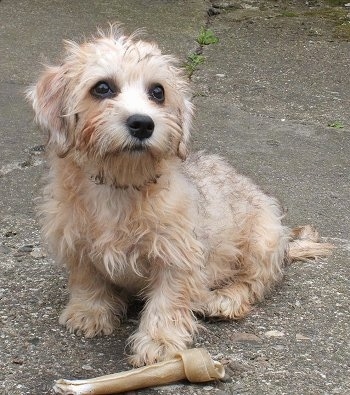
THIS IS A PUP OF IT'S BREED.
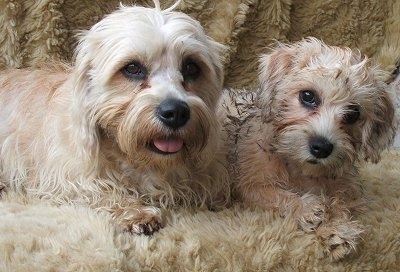
The breed has short legs, with an elongated body. Unusually among Scottish terrier breeds, it has pendulous ears. The neck is muscular, having developed from the breed's use against larger game.The typical height at the withers is 8–11 inches (20–28 cm), and they can weigh anywhere between 18–24 pounds (8.2–10.9 kg). While the Dandie generally is a hardy breed, it may have issue climbing stairs.They have a silky coat which forms a "topknot" on top of the dog's head.The Dandie Dinmont Terrier has a similar body shape to the Skye Terrier, but the Skye's coat is thicker and longer.The coat comes in two colour ranges, either "pepper" or "mustard". Pepper ranges from a dark blueish black through to a very light silvery gray, while the mustard can vary from reddish browns to a fawn where the head appears to be almost white. Typically, the legs and feet are of a darker colour with the lighter colour on the body slowly blending into that on the legs.The depth of the coat can reach up to 2 inches (5.1 cm). The colour of the coat is usually set by the time the dog reaches eight months of age, but the Dandie Dinmont Terrier will continue to mature physically until around two years old.

The breed is tough but usually friendly, and are suitable for older children. It makes both a good companion and a guard dog, but are among the most docile of the terrier breeds and are usually quite undemanding of their owners. However they are known for their ability to dig large holes in a short space of time. They can be trained to be good with cats, but should not be trusted around smaller animals such as hamsters or rats. They are described as being "very game", in that they are prone to challenging other animals including foxes, and in some cases other dogs.Due to the breed's elongated body, there can be back issues within the breed specifically with intervertebral discs in the dog's backs. These discs can sometimes "slip" resulting in spinal disc herniation. Any symptoms relating to this can depend entirely on what part of the dog's back is affected, and can range to paralysis with loss of bladder and bowel control in the worst cases.
Following work by the breed clubs to ensure that any reoccurring health issues are dealt with, there are no especially common conditions affecting the Dandie Dinmont Terrier. However, minor issues affecting the breed can include hypothyroidism, primary closed angle glaucoma and Cushing's syndrome. In order to combat glaucoma in the breed, the breed clubs recommend that Dandies should have a procedure called a gonioscopy conducted on them at regular intervals throughout their lives. The Dandie is also at slightly higher risk of canine cancer than average. The average life expectancy of a Dandie Dinmont Terrier is 11–13 years.

HEDGEHOGS

hedgehog is any of the spiny mammals of the subfamily Erinaceinae, which is in order Erinaceomorpha. There are seventeen speciesof hedgehog in five genera, found through parts of Europe, Asia, Africa and New Zealand (by introduction). There are no hedgehogs native to Australia, and no living species native to the Americas. Hedgehogs share distant ancestry with shrews (family Soricidae), with gymnures possibly being the intermediate link, and have changed little over the last 15 million years. Like many of the first mammals, they have adapted to a nocturnal way of life.[3] Hedgehogs' spiny protection resembles that of the unrelated rodent porcupines and monotreme echidnas.The name hedgehog came into use around the year 1450, derived from the Middle English heyghoge, from heyghegge ("hedge"), because it frequents hedgerows, and hogehogge ("hog"), from its piglike snout. Other names include urchinhedgepig and furze-pig. The collective noun for a group of hedgehogs is array or prickle.

THIS IS A DRAWING OF A HEDGEHOG
Hedgehogs are easily recognized by their spines, which are hollow hairs made stiff with keratin. Their spines are not poisonous or barbed and, unlike the quills of a porcupine, cannot easily be removed from the hedgehog. However, spines normally come out when a hedgehog sheds baby spines and replaces them with adult spines. This is called "quilling". When under extreme stress or during sickness, a hedgehog can also lose spines.Hedgehogs are primarily nocturnal, although, depending on the species, they may be more or less active during the day. The hedgehog sleeps for a large portion of the daytime either under cover of bush, grass, rock or in a hole in the ground. Again, different species can have slightly different habits, but in general hedgehogs dig dens for shelter. All wild hedgehogs can hibernate, although not all do; hibernation depends on temperature, species, and abundance of food.
DID U KNOW THAT BABY  HEDGEHOGS HAVE SOFT
WHITE RUBBER LIKE SPIKES?
The hedgehog's back is made up of two large muscles, which control the positioning of its quills. There are about 5,000 to 6,500 quills on the average hedgehog, and these are strong on the outer surface, but filled with air pockets on the inside. The hedgehog uses its quills to protect itself from predators, using muscles which draw their quilled skin to cover their full body, and pulling in the parts of their bodies not covered, such as their head, feet, and belly. This form of defense is the hedgehog's most successful, but is usually their last resort.Hedgehogs are fairly vocal and communicate through a combination of grunts, snuffles and/or squeals, depending on species.Hedgehogs occasionally perform a ritual called anointing. When the animal encounters a new scent, it will lick and bite the source, then form a scented froth in its mouth and paste it on its spines with its tongue. The specific purpose of this ritual is unknown, but some experts believe anointing camouflages the hedgehog with the new scent of the area and provides a possible poison or source of infection to predators poked by their spines. Anointing is sometimes also called anting because of a similar behavior in birds.Similar to opossums, mice and moles, hedgehogs have some natural immunity against snake venom due to the protein erinacin in the animal's muscular system (although it is only available in small amounts, and so a viper bite, for example, may kill the hedgehog anyway).

Wednesday, January 8, 2014

Basenji

The Basenji, which originated in Africa, is a small, short haired and athletic dog with a smooth shiny coat and is the size of a fox terrier. They have a shiny coat of a number of different colors usually having white feet as well as white on the chest and tip of the tail. The Basenji is an elegant dog with long legs and a level back. Many think they have a perpetual worried look on their face because of the deep wrinkles in their forehead. The tail is high up, but curls up and slightly over to the side of its back. The ears are erect, straight and open in the front similar to a German shepherd, although some say they resemble a small deer. The small almond shaped eyes make the Basenji appear to be squinting. They enjoy doing what they were born for: hunting and running.The Basenji only comes in heat once a year, in the fall.The one trait that the Basenji is most known for is the fact it does not bark. This is not to say that it is a mute dog by any means. Depending on what their mood is at the time, they will whine, squeal or howl and give one single 'woof' from time to time. When the Basenji is upset about something like being locked up, they will let out a scream that is similar to a woman or baby screaming or a rooster crowing. They do make a sound called a yodel or baroo that is attributed only to their breed. Overall, when they want to be heard, they know what to do and they are heard. 

Basenjis can be hard to train because they can be very stubborn.They are very destructive dogs and will chew on things much more so than most dogs.There are four basic colors:

THIS IS A FAMILY OF THE BREED 'BASENJI'.
  •  Red,
  •  black,
  •  tricolor, which consists of black with tan in their traditional pattern) 
  •  brindle (red with black stripes)AND each of these with white on the tail, chest and feet.
They can live outdoors with a big yard or in an apartment provided,they get exercise daily and lots of it.The Basenji is a very old breed of dog with his origin stemming way back to ancient times. It has been said that they originated in Africa and considered an "African import" at some point. In the late 1800s, they were prized as hunting dogs in the Congo because of their great speed and intelligence as they would track their wild game right into nets while waiting for the master to come. They are very alert, energetic and affectionate, yet they are also demanding. The Basenji needs to be handled and have human contact from a very young age to truly make a good pet. They do not like small animals and will chase them until they catch and kill them, if given the chance. Another characteristic of the Basenji is their inability to get along with other dogs, especially if they are a dominant dog.This is especially true when it is the a dog of the same gender.Many owners of Basenji have said that they get along fine with other Basenji dogs, just not dogs of another breed.They are very intelligent dogs and bond very strongly with their family members. Basenjis are somewhat shy and aloof with strangers and may actually "circle" them like prey if left unsupervised. When they circle something, this usually means that they consider it a threat to them or their home. They are territorial and very protective of their home and any area they spend a lot of time in and consider as "theirs". They are very playful dogs that need much play time and exercise to release some of their energy.

 They are very loving dogs with their owners, but need to have constant attention and human contact. Many owners say that their Basenji is like a 2-year-old child with their demands for attention and if they don't get it, they make you regret it by being destructive.
There are a few diseases and disorders that the Basenji is prone to getting:
THIS IS A BASENJI MOTHER WITH IT'S PUP.
  1. Fanconi Syndrome is an inheritable kidney disorder that usually will Show its symptoms after the age of four.
  2. Genetic Hemolytic Anemia, a blood disorder, is common with Basenji dogs that are carriers.
  3. Hip dysplasia is a disorder that can cause loss of mobility, lameness and painful arthritis in the joints. It can be mild to severe where it will cripple the dog.
  4. Malabsorption is an autoimmune intestinal disease that if left untreated can lead to death.
  5. Progressive Retinal Atrophy, which is a degeneration of the retina of the eye, may lead to total blindness and other less serious eye problems.
They are highly energetic dogs that need more than just an occasional walk around the block.Basenjis do not like to be around or in water and will avoid it at all costs. You will have to almost trick them to get them in water. Although, if they are in pursuit of something, they have been know to run in the rain.