Sunday, April 7, 2013

Ragdoll

The Ragdoll is a cat breed with blue eyes and a distinct color point coat. It is a large and muscular semi-longhair cat with a soft and silky coat.Developed by American breeder Ann Baker, it is best known for its docile and placid temperament and affectionate nature. The name "Ragdoll" is derived from the tendency of individuals from the original breeding stock to go limp and relaxed when picked up.The docile and floppy nature of the Ragdoll is a characteristic thought to be passed down from the Persian and Birman breed. Opinions vary as to whether this trait might be the result of genetic mutation. The extreme docility of some individuals has led to the myth that Ragdolls are pain-resistant. Some breeders in Britain have tried to breed away from the limpness due to concerns that extreme docility "might not be in the best interests of the cat".multiple occasions, ragdolls have been reported as nonchalantly approaching moving cars and vicious dogs and getting hurt. Breed standards describe the Ragdoll as affectionate, intelligent, relaxed in temperament, gentle, and easy to handle.
THREE CUTE RAGDOLL KITTENS

The Ragdoll is one of the largest domesticated cat breeds with a sturdy body, large frame, and proportionate legs. A fully-grown female weighs from 8 to 15 pounds (3.6 to 6.8 kg). Males are substantially larger, ranging from 12 to 20 pounds (5.4 to 9.1 kg) or more.The genes for point coloration are also responsible for the blue eyes of the Ragdoll. More intense shades of blue are favored in cat shows. Ragdolls come in 6 different colors: seal; chocolate; flame; and the corresponding "dilutes", including blue, lilac, and cream. This also includes the tortoiseshell pattern in all colors and the three patterns. All Ragdoll kittens are born white. They have good color at 8 – 10 weeks and full color and coat at 3 – 4 years.


The four different patterns are:
CREAM POINT RAGDOLL CAT!
  • Pointed - One color darkening at the extremities (nose, ears, tail, and paws).
  • Mitted - Same as pointed, but with white paws and abdomen. With or without a blaze (a white line or spot on the face), but must have a "belly stripe" (white stripe that runs from the chin to the genitals) and a white chin.
  • Bicolor — White legs, white inverted 'V' on the face, white abdomen and sometimes white patches on the back. (Excessive amounts of white, or "high white", on a bicolor is known as the Van pattern, although this doesn't occur nearly as often as the other patterns.)
  • Lynx - A variant of the above type having tabby markings.

English Setter

The English Setter is a breed of dog. It is part of the Setter family, which includes red Irish Setters, Irish Red and White Setters, and black-and-tan Gordon Setters. It is a gun dog, bred for a mix of endurance and athleticism.The coat is flat with light feathering of long length or short length depending on the type. The bench or show type has a long, flowing coat that requires regular grooming. The field or hunting type has a shorter coat that requires less grooming.The various speckled coat colors when occurring in English Setters are referred to as belton; valid combinations are white with black (blue belton), white with orange flecks (orange belton)), white with orange flecks and lighter nose (lemon belton), white with liver flecks (liver belton), or "Tricolor" which is blue or liver belton with tan markings on the face, chest, and legs.

THIS IS A PAINTING OF THREE ENGLISH SETTERS
This breed's standard temperament is best described as a "Gentleman by Nature". However, it can also be strong-willed and mischievous. English Setters are energetic, people-oriented dogs, that are well suited to families who can give them attention and activity, or to working with a hunter, where they have a job to do. They are active dogs outside that need plenty of exercise in a good sized fenced-in yard. Inside they tend to be lower energy and love to be couch potatoes and lap dogs that love to cuddle. Many are good around children. However, they are not always easy to train, as their natural bird instinct tends to distract them in outdoor environments.Their temperament is considered a soft one. Therefore they are very sensitive to criticism, and could be unwilling to repeat a behavior out of fear to disappoint the trainer. Positive reinforcement training methods therefore work best for English Setters.

AN ENGLISH SETTER PUP
The English Setter was originally bred to set or point upland game birds. From the best available information, it appears that the English Setter was a trained bird dog in England more than 400 years ago. There is evidence that the English Setter originated in crosses of the Spanish Pointer, large Water Spaniel, and English Springer Spaniel, which combined to produce an excellent bird dog with a high degree of proficiency in finding and pointing game in open country.The breed is still fairly well represented in Italy, where it is popular as a working gun-dog. The English setter is one of the most popular and elegant sporting breeds, often grouped with its cousins, the Irish and Gordon Setters.

Saturday, April 6, 2013

Boykin Spaniel

 Boykin Spaniel is a medium-sized breed of dog, a Spaniel bred for hunting wild turkeys and ducks in the Wateree River Swamp of South Carolina, in the United States. It is the state dog of South Carolina.The Boykin Spaniel is only slightly larger than the English Cocker Spaniel but much heavier through the body width. Height at the withers for males ranges from 15.5 - 17 ins (39.4 - 43.18 cm) and weight 30 - 40 lbs (13.6 - 18.2 kg). Females are smaller, 14 - 16.5 ins (35 - 41.91 cm) and 25 - 35 lbs (11.4 - 15.9 kg). Although against the true form and function of the breed, some field trial breeders are increasing their line's size to be competitive against other retriever breeds. Buyers should be aware of the size and weight in the puppy's pedigree before choosing a breeder if size is a factor in their choice of dog. Traditionally, its tail is docked at the age of three days, leaving 1/3 length. Eyes are engaging and bright. The color ranges from brilliant gold to a dark amber. Puppies will have milky bluish-gold to amber eyes until a few months old. The coat color comes in liver or chocolate (shades of brown).
THIS IS A DRAWING OF A
BOYKIN SPANIEL HOLDING A DUCK.
The Boykin Spaniel is a versatile hunter, working as a retriever and upland hunter, flushing birds into flight. Pointing is not in character with the Boykin's hunting style. Their stamina in hot weather and eagerness make them good for dove hunts, but also for pheasant and other upland game. They can be used in driving deer or in tracking wounded game. Their small size makes them easy to carry in a canoe or other small boat, and they are described as "the dog that doesn't rock the boat''. Boykin Spaniel is quickly becoming one of the most common spaniel breeds in America. Boykin spaniel are adapted to various weather conditions. The attractive and good -natured  boykin spaniel  is promoted as a rare breed pet.
BOYKIN  SPANIEL PUPPIES
The Boykin Spaniel is a friendly, social dog that is considered a good family pet. It is easily trained and eager to work. It is good with, and extremely stable around, children and other dogs. They can sometimes be described as energetic with great endurance that lasts throughout the day. They are extremely adaptable to different environments as long as they are given ample opportunity for social interaction and plenty of time to burn off excess energy. They are not easily angered and tend to be eager to please and friendly, but they love attention. Boykins have great energy reserves and will always outlast you in any activity you choose.As with all dogs, the Boykin Spaniels require daily exercise and regular grooming. Clipping the coat regularly is recommended especially if the dog is in the field, as the soft coat collects fox tails and briars. Spraying the dog with cooking spray is also recommended to help defend against tangles in the long fur.

Thursday, May 24, 2012

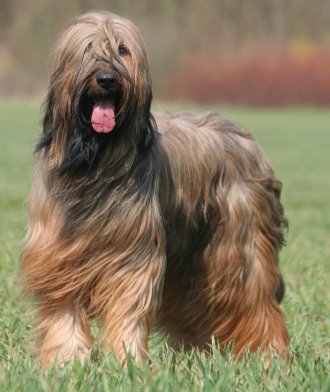
Briard

The Briard can be characterized as a large and muscular herding dog. In addition to the herding the Briard was also used as a guard dog. This makes the Briard a natural watch dog that has strong loyalties to its owner and family. They are very eager to please and learn tasks very quickly. Due to their history of being farm dogs they were taught many tasks. They have excellent memory for commands and are able to work independently. This independent personality does not take away from its loving and affectionate nature with its family. 
The Briard has a strong and powerful stature combined with the agility needed for a herding dog. The head of the Briard should give the impression of length with clean lines and no excess skin or jowls. The head should also be held high and alter and should connect to the neck at a 90 degree angle. The ears should be set high on the head and should have a thick leather to be firm at the base. The ears can be either cropped or not cropped. The muzzle has a moustache and beard and should be considered somewhat wide and end in a right angle. Their muscular build is emphasized in their chest. The chest is broad and deep with moderately curved ribs. The shoulder blades are to be long and muscular. The front legs and rear legs are to be the same distance apart. The legs are to be straight and parallel to the median of the body. The form of the legs is very important because they are what will determine the dog's ability to herd and keep its agile movement. The rear legs are very powerful and help provide flexibility. The rear legs are to have two dewclaws that are lower set on the leg. This will give foot the appearance of having a wide base.


A STAMP OF A BRIARD
The Briard's coat is very coarse and strong. It is slightly wavy double coat. It is really similar to the coat of goats. Dirt and water do not easily attach to the coat. The coat if well groomed sheds very little. The average length of an adult Briard's coat is at least 6 inches. The length of the coat gives it a very attractive bushy appearance with a beard, moustache, and eyebrows. The undercoat of the Briard is much finer than that of the outer coat. Due to the softness and fineness of the undercoat it is prone to matting. The coat can be worn either long or shorter depending on owner's preference and level of coat maintenance desired.

MOTHER BRIARD AND HER TWO
LITTLE PUPS
The Briard is a very loving and loyal dog. They are extremely intelligent without a hint of shyness. They are said to be a dog of heart with a light spirit and who become very loyal to their owners and families. They loyalty extends into being protective of their family as well so introductions to new people and animals should always be on the dog's terms. This includes new introductions into the family such as furniture or a new child. The Briard needs to be shown that new introductions are a positive experience. Further to this, socialization is very important with the Briard because of this protective nature. Socialization should start an early age and should consist of meeting all different kinds of people and going to several different types of places. If living in a home with children they are very loving and gentle when raised together. This is the same for other animals. The Briard is known to be a bit dog aggressive, but with proper socialization and handling can co-exist with other pets and animals well.The Briard is definitely not a dog for everyone. They can be very stubborn and independent and sometimes very unfriendly and fearful when not raised properly. They respond very poorly punishment or severe training. They can become very withdrawn and sometimes even violent when treated negatively. It is important to train them using a more positive approach. Clicker training and food reinforcement training are examples of positive training methods. This breed is very sensitive to being teased. Further to this, because of their training and history of being herding dogs, Briards are likely to nip at people's heels with the intentions of herding them where the dog thinks they should go.When raised properly are very affectionate and warm family dogs. It is said that they will return ten fold the amount of affection that they are given. They do crave excitement and entertainment and therefore are not the type of dog that can just be left to roam and relax around the house. It is important for the Briard to have daily exercise and entertainment. Their love of the outdoors and for activity makes them excellent pets for the active individual or family.

TWO BRIARD PUPS PLAYING TOGETHER
The Briard does best in a home with a moderately fenced yard because it loves the outdoors. They typically will do fine being outside alone and in a fenced yard because they do have a sense of independence. However, they are quite content living in the home with the family. They are moderately active indoors and therefore do need some space to move around. Despite this, they can adjust to live happily in an apartment style environment if the owner is dedicated to providing the dog with enough daily exercise outside the home. They will do moderately well as kennel dogs, but again this is not suggested because of their love and need for activity and the outdoors.

Monday, February 27, 2012

Golden Parakeet or Golden Conure

The Golden Parakeet or Golden Conure, Guaruba guarouba, formerly classified as Aratinga guarouba,is a species of Neotropical parrot. Sometimes known as the Queen of Bavaria Conure, it is the only species (monotypic) in the genusGuaruba.Its plumage is mostly bright yellow, hence its common name, but it also possesses green remiges. It lives in the drier, uplandrainforests in Amazonian Brazil, and is threatened by deforestation and flooding, and also by the now-illegal trapping of wild individuals for the pet trade.The Golden Parakeet is mainly yellow with green in outer wings and with an all-yellow tail. It has a large horn-coloured beak, pale-pink bare eye-rings, brown irises, and pink legs. Male and female have identical external appearance. Juveniles are duller and have less yellow and more green plumage than the adults. The juvenile's head and neck are mostly green, the back is green and yellow, the upper side of tail is mostly green, the breast is greenish, the eye-rings are pale-grey, and the legs are brown.
A DRAWING OF TWO GOLDEN
PARAKEETS
The Golden Parakeet is distributed in the northern parts of Brazil Golden Parakeets are a sociable species, living, feeding, sleeping and even breeding together.They eat fruits, flowers, buds, seeds, and cultured maize in the wild. These include the seed of Croton matouensis, which is related to the castor bean plant;Muruci fruit (Byrsonima crispa); mangoes; and AçaĂ­ fruits. The birds studied for a 1986 study used two different habitats during the year; during the non-breeding season, which coincided with the dry season, they occupied the tall forest. During the breeding season they left the tall forest and entered open areas on the edge of the forest such as fields used in agriculture.
Golden Parakeets are a sociable species, living, feeding, sleeping and even breeding together. They eat fruits, flowers, buds, seeds, and cultured maize in the wild. These include the seed of Croton matouensis, which is related to the castor bean plant;Muruci fruit (Byrsonima crispa); mangoes; and AçaĂ­ fruits.Golden Parakeets.It is a species of Neotropical species.


THREE SMALL GOLDEN PARAKEETS

The Golden Parakeet has a breeding system that is almost unique amongst parrots, as pairs are aided by a number of helpers which aid in the raising of the young. This behavior is less common with parakeets in captivity, who often abandon their young after three weeks.After the Golden Parakeet reaches sexual maturity at the age of three years, the breeding season starts in November and runs through February. They nest in a high tree, in deeper than average nesting cavities, and lay an average of four 37.1-by-29.9-millimeter (1.46 by 1.18 in) eggs, which they aggressively guard. The incubation period is about 30 days, in which the male and female take turns incubating. In the first few years of sexual maturity, Golden Parakeets tend to lay infertile clutches until the age of six to eight. In captivity, Golden Parakeets will resume breeding when their chicks are taken from them.At birth, Golden Parakeets are covered in white down that eventually turns darker within a week. By the end of the third week, wing feathers start to develop. Juveniles are playful, but may turn abusive against their peers.Nestlings are preyed upon by toucans, a fact that may explain their social behavior. Nests are vigorously defended from toucans by several members of the group.
TWO GOLDEN PARAKEETS
EATING FOOD

This is largely due to deforestation and the capture of wild birds for aviculture, where it is in high demand due to the attractiveness of its plumage. Locally, they are considered as pests for feeding on crops, and are hunted for food or sport.An example of the displacement of Golden Parakeets by habitat loss comes from the building of the TurucuĂ­ Dam, Pará, from 1975-1984. More than 35,000 forest dwellers were forced from what had been a habitat that was considered to be "among the richest and most diversified in the world." In addition, 2,875 square kilometers (1,110 sq mi) of rainforest were flooded, and 1,600 islands were produced by the flooding, all of which were heavily deforested

Tuesday, January 24, 2012

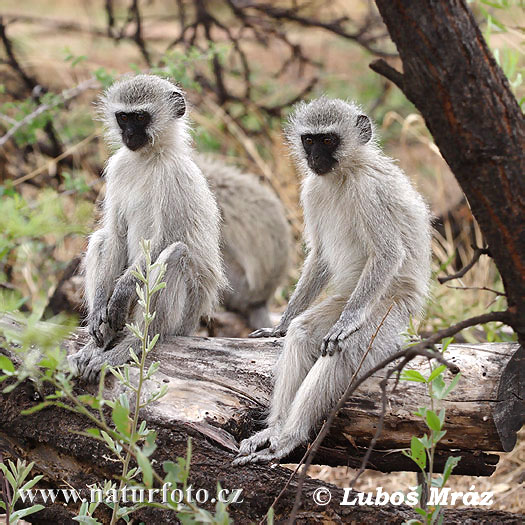
Vervet Monkey

The Vervet Monkey is a medium to large sized monkey that is primarily found in Eastern Africa. The Vervet Monkey is thought to be a species of Grivet, another tree-dwelling African monkey that has very similar characteristics to the Vervet, along with the Malbrouck which is considered by some to be a sub-species of Vervet Monkey. These three animalsare very closely related but they tend to inhabit territories in slightly different locations and are thought to rarely come into contact with one another. There are currently six recognised sub-species of the Vervet Monkey that are generally classified depending on their location, although there is some difference in colouration between them.
BABY VERVET MONKEYS
PAINTING
The Vervet Monkey grows to an average of 50cm tall, with a tail that is often longer than the body itself and has a black tip. Their fur tends to be grey or olive in colour (depending on the species) and is lighter on their underside. The hands and feet of the Vervet Monkey are black, along with their ears and face which has a white band above it and is also framed by white cheek tufts. The Vervet Monkey has long arms and legs which are about the same length to allow this species to walk on all fours when on the ground with ease, and actually makes them quite speedy when running. Males tend to be larger than females and are easily distinguished by their bright blue testicles.
VERVET MONKEY STAMP
The Vervet Monkey is found south of the Sahara and is widespread across Eastern Africa. They are also found in parts of southern and western Africa from Uganda to Ghana but their location is generally dependant on the sub-species. The Vervet Monkey inhabits savanna, woodland and forests that tend to be close to water, preferring acacia forests that line rivers and lakes. Vervet Monkeys can also be found in mountainous regions up to 1,300 feet providing that there is an adequate supply of both food and water to sustain the population. They are rarely found in more extreme environments such as deserts and rainforests as these regions simply do not have everything that Vervet Monkeys require to successfully survive.
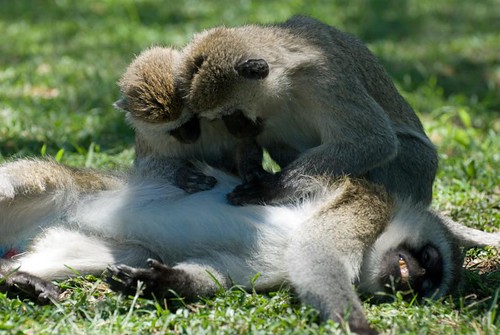
TWO VERVET MONKEYS ARE
GROOMING ANOTHER VERVET
MONKEY
The Vervet Monkey is an arboreal monkey which means that it spends most of it's time in the safety of the trees. Although they do venture down to the ground in search of both food and water, Vervet Monkeys rarely go further than 450 meters from the trees, which helps to protect them from predators. They are diurnal animals spending the days foraging for food and then rest at night. The Vervet Monkey is a very sociable animal inhabiting territories in troops that can contain between 10 and 50 individuals, depending on the location and how ample the food supply is. These troops are comprised of adult females and their young, with males wandering between different troops to both socialise and mate.

BABY VERVET MONKEY WITH
IT,S MOTHER

The Vervet Monkey is not usually able to reproduce until they are about five years old, although their age of sexual maturity is known to vary slightly and may be dependent on how much food they have access too. After about 5 and a half months, females give birth to a single infant which is cleaned by it's mother at birth, and clings to her stomach during the first week or so. Vervet Monkey babies quickly develop strong social bonds with other monkeys and are known to begin interacting and playing with them by the time they are a month old. They have pink faces and black fur and don't tend to develop their adult colouration until they are a few months old. Vervet Monkey offspring suckle on their mother's milk until they are nearly four months old and start to eat softer vegetation, but they are not fully weaned until they are about a year old.
VERVET MONKEY TEACHING TO
IT,LITTLE KID
Despite the fact that the Vervet Monkey tends to reach sexual maturity after a number of years in the wild, sexual maturity in captivity tends to occur much sooner at an average age of two years old. They are incredibly well adapted to their surrounding environments as they can jump and climb well when in the trees and are pretty speedy on the ground, along with being excellent swimmers. Younger females in the troop that are not yet mature, often show a keen interest in the offspring of adult females and assist them with grooming and caring for their young. They are also known to love to hold them, making it not wonder that social bonds within the troop particularly between relatives, often last for life.

Tuesday, January 10, 2012

Budgerigar

The Budgerigar (Melopsittacus undulates) , also known as Common Pet Parakeet or Shell Parakeetinformally nicknamed the budgie, is a small, long-tailed, seed-eating parrot, and the only species in the Australian genusMelopsittacus. Wild budgerigars are found throughout the drier parts of Australia, where the species has survived harsh inland conditions for the last five million years.Naturally green and yellow with black, scalloped markings on the nape, back, and wings, breeders have created a rainbow of blues, whites, and yellows, greys, and even forms with small crests. Budgerigars are popular pets around the world due to their small size, low cost, ability to mimic human speech and playful nature.The budgerigar is closely related to the lories and the fig parrots. Although budgerigars are often, especially in American English, called parakeets, this term refers to any of a number of small parrots with long, flat tails.
 A PAINTING OF A BUDGERIGAR

Budgerigars in their natural-habitats of Australia average 18 cm (7 in) long, weigh 30–40 grams (1.1–1.4 oz), and display a light green body colour (abdomen and rumps), while their mantle (back and wing coverts) display pitch-black mantle markings (blackish in fledgelings and immatures) edged in clear yellow undulations. The forehead and face is yellow in adults but with blackish stripes down to the cere (nose) in young individuals until they change into their adult plumage around 3–4 months of age. They display small, purple patches (called cheek patches) and a series of three black spots across each sides of their throats (called throat-spots). The two outermost throat-spots are situated at the base of each cheek-patch. The tail is cobalt (dark-blue); outside tail feathers display central yellow flashes. Their wings have greenish-black flight feathers and black coverts with yellow fringes along with central yellow flashes, which only becomes visible in flight or when the wings are outstretched. Bills are olive grey and legs blueish-grey, with zygodactyl toes.Budgerigars in their natural habitat in Australia are noticeably smaller than those in captivity. This particular parrot species has been bred in many other colors and shades in captivity (e.g. blue, grey, grey-green, pieds, violet, white, yellow-blue), although they are mostly found in pet stores in blue, green, and yellow. Like most parrot species, budgerigar plumage fluoresces under ultraviolet light. This phenomenon is possibly related to courtship and mate selection.
TWO SMALL BUDGERIGAR


Breeding in the wild generally takes place between June and September in northern Australia and between August and January in the south, although budgerigars are opportunistic breeders and respond to rains when grass seeds become most abundant.Budgerigars show signs of affection to their flockmates by preening or feeding one another. Budgerigars feed one another by eating the seeds themselves, and then regurgitating it into their flockmates' mouth. Populations in some areas have increased as a result of increased water availability at farms.Nests are made in holes in trees, fence posts, or logs lying on the ground; the 4-6 eggs are incubated for 18–21 days, with the young fl edging about 30 days after hatching.In the wild, virtually all parrot species require a hollow tree or a hollow log as a nest site. Because of this natural behavior, budgerigars most easily breed in captivity when provided with a nest box. The eggs are typically 1 to 2 centimeters long and are plain white without any coloration. Female budgerigars can lay eggs without a male partner but these eggs are unfertilized and will not hatch. When the female is laying eggs her cere turns a crusty brown colour. A female budgerigar will lay her eggs on alternate days. After the first one, there is usually a two-day gap until the next. She will usually lay between four to eight eggs, which she will incubate (usually starting after laying her 2nd  or 3rd) for about 21 days each. Female Budgerigar only leave their nests for very quick defecation's and stretches once they've begun incubating and are by then almost exclusively fed by their mate (usually at the nest's entrance).Depending on the clutch size and the beginning of incubation, the age difference between the first and last hatch ling can be anywhere from 9 to 16 days. Rarely, the female has the habit of eating the eggs in case of insecurity.

 ALL THE COLORS OF BUDGERIGAR

Eggs take about 18–20 days before they start hatching. The hatchlings are altricial – blind, naked, totally helpless, and their mother feeds them and keeps them warm constantly. Around 10 days of age, the chicks' eyes will open, and they will start to develop feather down. The appearance of down occurs precisely at the ages (around 9 or 10 days of age) for closed banding of the chicks. Budgerigar's closed band rings must be neither larger or smaller than 4.0 to 4.2 mm.They develop feathers around 3 weeks of age. (One can often easily note the colour mutation of the individual birds at this point.) At this stage of the chicks' development, the male usually has begun to enter the nest to help his female in caring and feeding the chicks. Some budgerigar females, however, totally forbid the male from entering the nest and thus take the full responsibility of rearing the chicks until they f ledge.Depending on the size of the clutch and most particularly in the case of single mothers, it may then be wise to transfer a portion of the hatch lings (or best of the fertile eggs) to another pair. The foster pair must already be in breeding mode and thus either at the laying or incubating stages and/or rearing hatch lings.As the chicks develop and grow feathers, they are able to be left on their own for longer and longer periods of time. By the fifth week, the chicks are strong enough that both parents will be comfortable in staying more and more out of the nest. The youngsters will stretch their wings to gain strength before they attempt to fly. They will also help defend the box from enemies mostly with their loud screeching. Young budgerigars typically f ledge (leave the nest) around their fifth week of age and are usually completely weaned a week later. However, the age for fl edging as well as weaning can vary slightly depending on whether it is the oldest, the youngest and/or the only surviving chick. Generally speaking, the oldest chick is the first to be weaned. But even though it is logically the last one to be weaned, the youngest chick is often weaned at a younger age than its older sibling(s). This can be a result of mimicking the actions of older siblings. Lone surviving chicks are often weaned at the youngest possible age as a result of having their parent's full attention and care.Hand-reared Budgies may take slightly longer to wean than parent-raised chicks. Hand feeding is not routinely done with budgerigars, due to their small size, and the fact that young parent raised birds can be readily tamed.